

 Facebook
 X
X
 Pinterest
 Copy Link
Why So Many Homeowners Are Downsizing Right Now

For a growing number of homeowners, retirement isn’t some distant idea anymore. It’s starting to feel very real.
According to Realtor.com and the Census, nearly 12,000 people will turn 65 every day for the next two years. And the latest data shows as many as 15% of those older Americans are planning to retire in 2026. And another 23% will do the same in 2027.
If you’re considering retiring soon too, here’s what you should be thinking about.
Why Downsize?
Now’s the perfect time to reflect on what you want your life to look like in retirement. Because even though your finances will be going through a big change, you don’t necessarily want to feel like you’re living with less.
But odds are, what you do want is for life to feel easier.
Easier to enjoy.
Easier to manage.
Easier to maintain day-to-day.
The Top Reasons People Over 60 Move
You can see these benefits show up in the data when you look at why people over 60 are moving. The National Association of Realtors (NAR) finds the top 4 reasons aren’t about timing the market or chasing top dollar. They’re about lifestyle:
- Being closer to children, grandchildren, or long-time friends so it’s easier to spend more time with the people who matter most
- Wanting a smaller, more functional home with fewer stairs and easier upkeep
- Retiring and no longer needing to live near the office, so it’s easier to move wherever you want
- Opting for something smaller to reduce monthly expenses tied to utilities, insurance, and maintenance
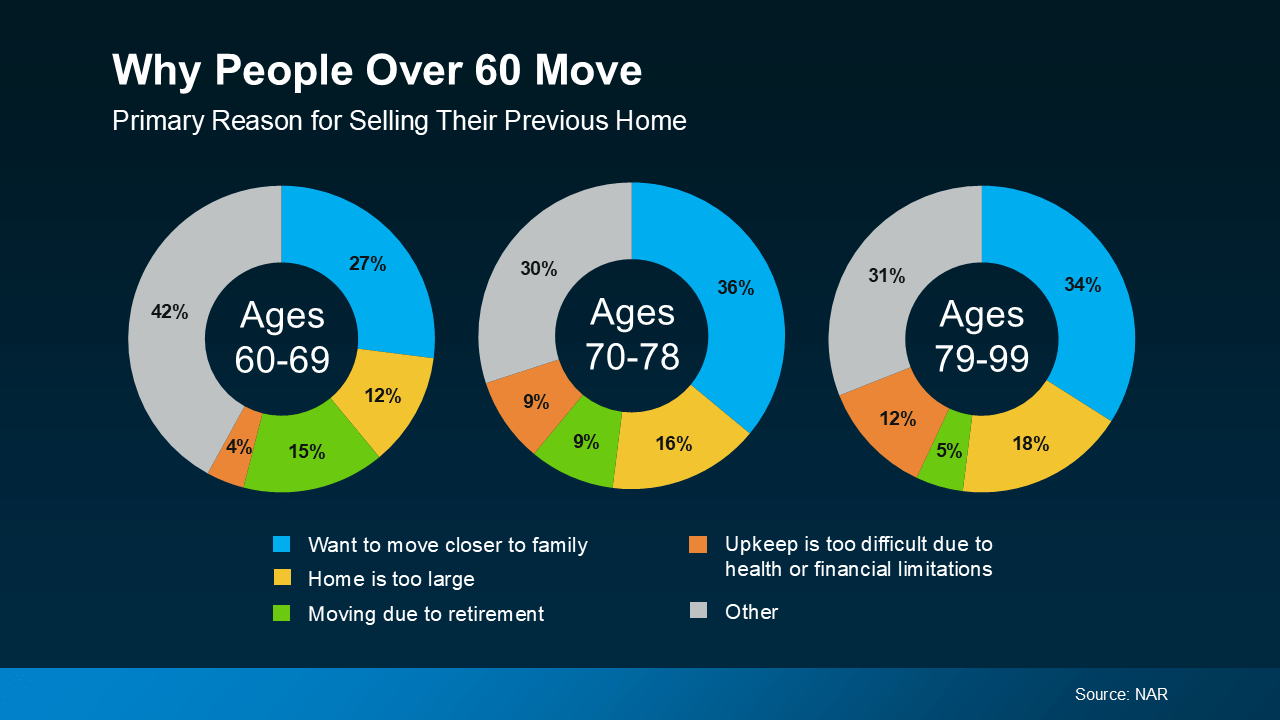
No matter the reason, the theme is the same: downsizing isn’t about giving something up. It’s about gaining control and choosing simplicity. And it brings peace of mind to know your home fits the years ahead, not the years behind.
And the best part? It’s more financially feasible now than many homeowners would expect.
The #1 Thing Helping So Many Homeowners Downsize
Here’s the part that makes it possible. Thanks to how much home values have grown over the years, many longtime homeowners are realizing they’re in a stronger position than they thought to make that move.
According to Cotality, the average homeowner today has about $299,000 in home equity. And for older Americans, that number is often even higher – simply because they’ve lived in their homes longer.
When you stay in one place for years (or even decades), two things happen at the same time:
- Your home value has time to grow.
- Your mortgage balance shrinks or disappears altogether.
That combination creates more options than you’d expect, even in today’s market.
So, whether you just retired, or you’re about to, it’s not too soon to start thinking about what comes next. Sure, it can be hard to leave the house you made so many years of memories in, but maybe it’s time to close one chapter to open a new one that’s just as exciting.
Bottom Line
Downsizing is about setting yourself up for what comes next – on your terms.
If retirement is on the horizon and you’ve started wondering what your current house (and your equity) could make possible, the first step isn’t selling. It’s understanding your options.
Let’s talk. A simple, no-pressure conversation can help you see what downsizing might look like – and whether it makes sense for you.
Top 2026 Housing Markets for Buyers and Sellers

Who doesn’t love a top 10 list? Well, here are two top 10 lists for the housing market this year. But before you take a look, there’s something you should know.
If a move is on your radar for 2026, here’s the most important thing you need to understand upfront: there isn’t one housing market this year – there are many.
Experts agree 2026 is shaping up to be one of the most geographically split housing markets in years. Some areas are tilting in favor of sellers, while others are opening real doors for buyers. Who has the advantage depends almost entirely on where you are. Selma Hepp, Chief Economist at Cotality, puts it this way:
“Looking ahead to 2026, regional differences will remain pronounced, with demand favoring areas that offer both economic opportunity and relative affordability.”
To show just how divided the landscape is, here’s a look at where sellers are expected to have the upper hand, and where first-time buyers may finally find their opening this year.
Where Sellers Are Poised To Win Big in 2026
Zillow identified the following metros as some of the strongest seller markets for 2026, based on buyer demand, pricing momentum, and how quickly homes are expected to sell:
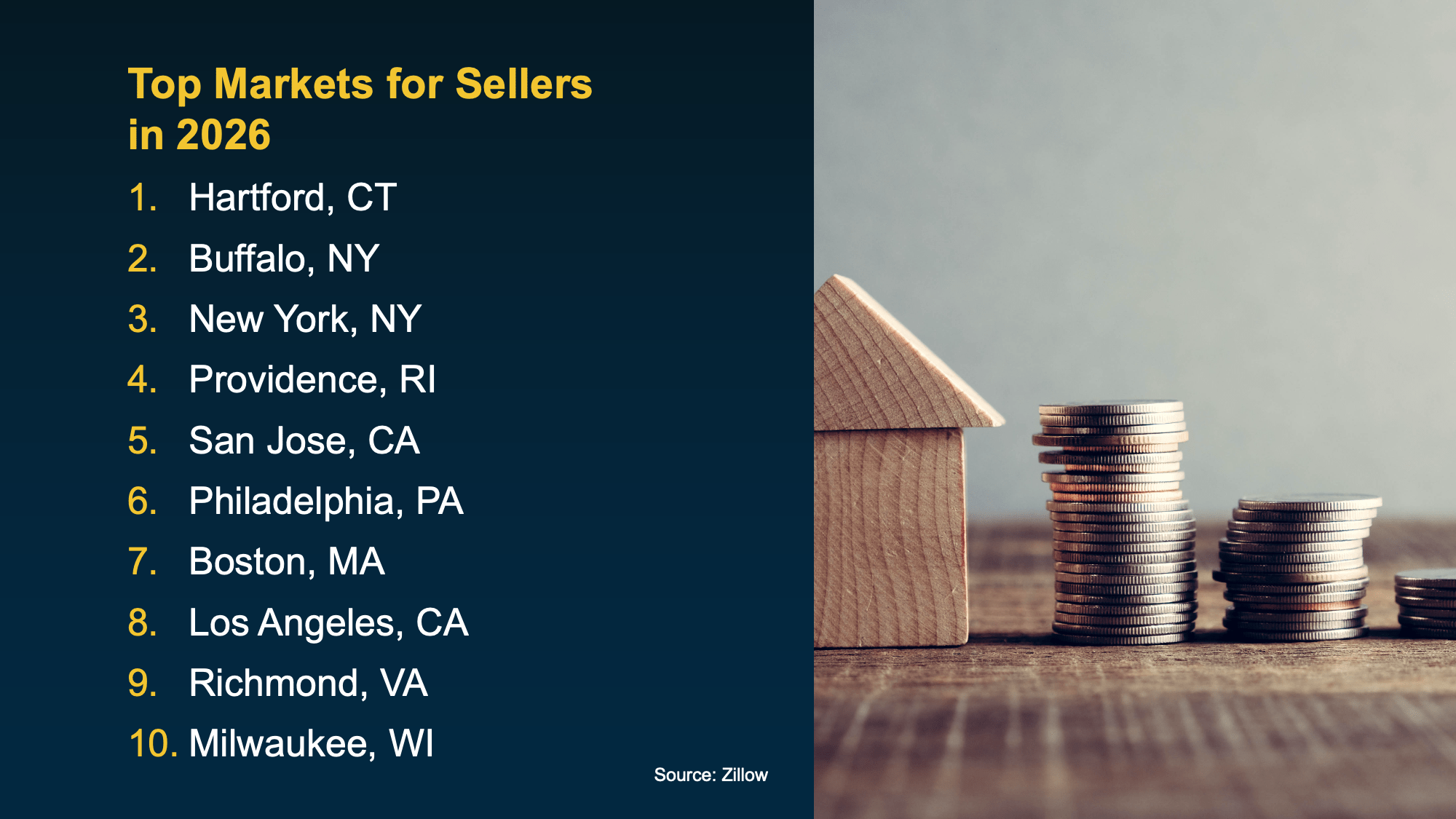 In markets like these, buyers are going to be competing for limited inventory, which gives sellers more leverage.
Homeowners in seller’s markets this year can expect:
- Stronger buyer interest
- Shorter time on market
- Better odds of selling close to (or above) asking price
That doesn’t mean every listing is guaranteed success. But it does mean sellers who prepare well and lean on an agent’s expertise should be very happy with their results in 2026.
Markets Where There’s More Opportunity for First-Time Buyers
On the flip side, here’s a look at where buyers have the power – in particular, first-time buyers, since they’ve had the hardest time breaking into the market lately. Realtor.com highlights the top metros where first-time buyers are expected to have better opportunities in 2026:
 These markets stand out for a mix of:
- More affordable home prices
- Better housing availability
- Strong local amenities and economic health
For first-time buyers, that combination matters. It’s what could finally turn “someday” into “this could actually work.” In buyer’s markets, they should expect:
- Less intense competition
- More room to negotiate
- A clearer path to getting an offer accepted
What Matters More Than Any Top 10 List
Not seeing your city on the list? Don’t stress. This is just a national snapshot, not a judgment on your local market. The goal here is just to show you how different the market really is depending on where you are.
And remember, you can buy or sell no matter how your local market leans. You just need an agent’s help to figure out the right strategy to get it done. For example:
- A seller in a more buyer-friendly metro may need to be aggressive on their price and prep.
- A buyer in a seller-leaning area may still need to come prepared with their best offer.
To find out where your market falls and what you should expect, you’ll want the help of a local expert.
Bottom Line
The housing market in 2026 isn’t one-size-fits-all. It’s a year where local conditions matter more than ever.
Whether your market leans more buyer-friendly or seller-friendly, the right strategy can put you in a strong position. And that’s where a local expert comes in. Let’s connect.
You May Not Want To Skip Over That House That’s Been Sitting on the Market
When you see a house that’s been sitting on the market for a while, the reaction is almost automatic. You start thinking:
- What’s wrong with it?
- Why hasn’t anyone bought it yet?
- Am I missing something?
That mindset made sense a few years ago. But in today’s market, you may actually miss out.
More Time on Market Isn’t Automatically a Concern Anymore
A few years ago, homes sold in just a matter of days. Sometimes, hours. Anything that lingered longer than that raised concerns. But that’s no longer the baseline.
Inventory has grown. Buyers have more choices. And homes are taking longer to sell across the board. Those are some of the reasons why the typical time it takes a home to sell has climbed this year:
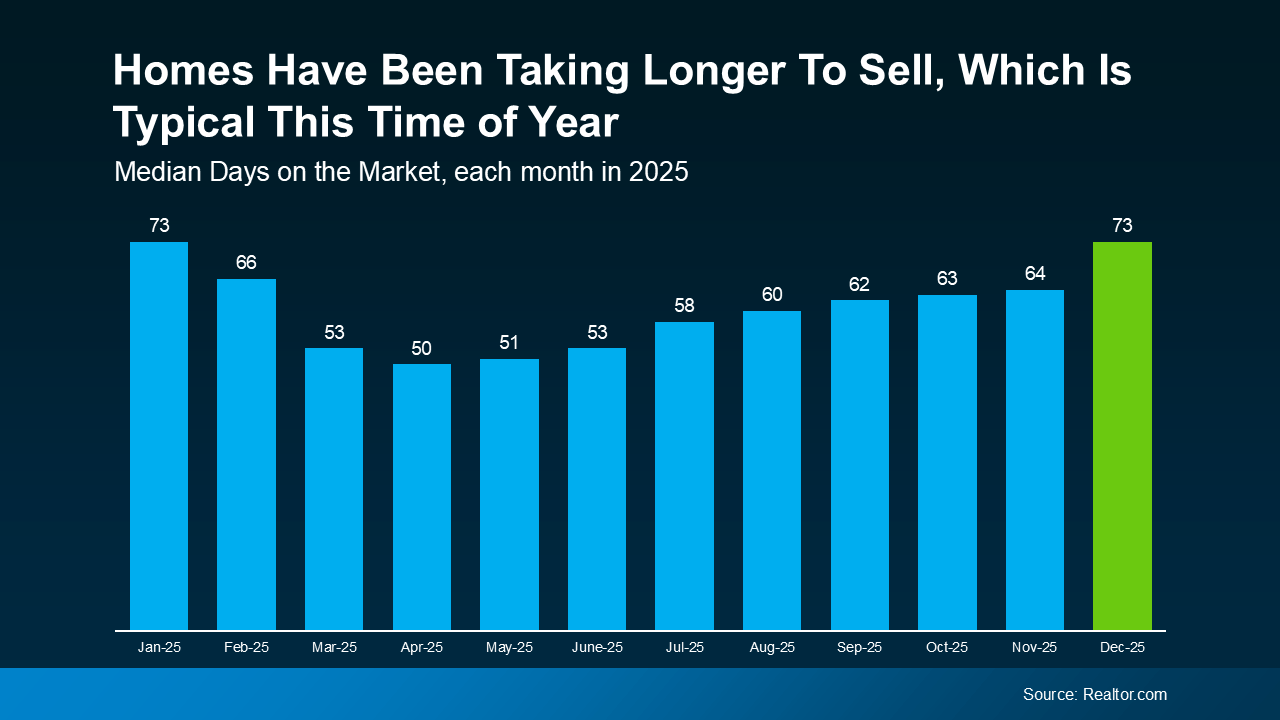 And it’s not that 73 days is slow. That’s actually pretty normal for this time of year. It just feels slow because you heard so much about houses being snapped up in the buying frenzy a few years ago.
That shift alone explains a lot of what you’re seeing. It’s not necessarily that there’s anything wrong with the house itself. Although, let’s be honest, sometimes that is the case.
Most of the time today, a house that’s taking longer to sell simply means:
- There are a lot of homes for sale in that area
- The seller priced a little too high at first
- The home didn’t photograph as well online
- Buyers passed it over for flashier listings nearby
- The timing just wasn’t right when it first hit the market
None of those are necessarily deal-breakers.
What Buyers Often Get Wrong About These Listings
Because even though you may assume a house that hasn’t sold must have hidden issues, the reality is, that’s not always the case. And, if the house does have issues, it’ll show up quickly in your inspection.
That’s information you can use to negotiate. Not a reason to walk away automatically. And in many cases, that’s where buyers find the best deals.
The key is knowing which homes that have been sitting for a while are worth a second look – and which ones aren’t. That’s why working with a local agent makes a real difference. They’ll be able to look at disclosures and more to help you uncover hidden gems other buyers may overlook.
Bottom Line
A home sitting on the market isn’t always a warning sign. Sometimes it’s an overlooked opportunity.
If you want help identifying which homes are worth a second look (and which ones to skip), let’s talk.
Mortgage Rates Recently Hit a 3-Year Low. Here’s Why That’s Still a Big Deal.

If you’re one of the thousands of homebuyers waiting for rates to fall, you should know it’s already happening. And they recently crossed an important milestone. Rates officially dipped their toes into the 5s – something that hasn’t happened in about 3 years.
This moment marked a critical threshold. Now, rates are sitting in the low 6% territory. And expert forecasts project they’ll hover near this range throughout the year.
Here’s why that’s so good for you.
Why Current Rates Are Such a Big Deal
A mortgage rate doesn’t just affect the interest you end up paying on your home loan. It shapes your entire buying experience.
When rates were up around 7% just one year ago, a lot of buyers felt priced out. Payments were higher. Budgets felt tighter. Affordability was a bigger challenge. That’s especially true for first-time homebuyers, who felt the biggest pinch.
But according to industry experts, that’s starting to change now that rates are slowly inching down. Let’s break down why.
Right now, borrowing costs are in their lowest range in almost 3 years. And that can change the type of home you can afford.
At 6% or below, you’ll see:
- Lower monthly payments. The payment on a $400k home loan is down over $300 compared to when rates were around 7%.
- More buying power, thanks to the extra breathing room in your budget.
In other words, you can now make a stronger offer, purchase in a different location, or buy a home that checks more of your boxes. And that feels like a big shift compared to when rates were at 7%.
This Opens the Door for 550,000 Buyers
To drive home just how much this helps potential homebuyers like you, consider this research from the National Association of Realtors (NAR). It shows that when mortgage rates sit around this level, millions more households can afford a home. When rates are at 6% or below:
- 5.5 million more households can afford the median-priced home
- And roughly 550,000 of those people will likely buy a home within 12 to 18 months
That’s not just speculation. That’s pent-up demand finally getting the green light they’ve been waiting for. You’ve got the chance right now to get ahead and buy before more people notice the game has just changed.
Because whether rates stay in the low 6s or dip back down into the upper 5s, the math is already working in your favor. And the difference from a low 6% to a high 5% isn’t as big as you may think. But the difference from 7% to 6%? That is very much a big deal, and it’s a number that’s already working in your favor.
An Important Call Out
Mortgage rates don’t operate in a vacuum. Home prices, local inventory, property taxes, home insurance, and your personal finances still matter.
And a rate in this territory doesn’t mean every home suddenly works for every buyer. That’s why getting pre-approved and running your numbers with a trusted lender is key.
Still, this rate environment puts more buyers in play than we’ve seen in years. So, if buying didn’t work for you before, it’s worth taking another look.
Bottom Line
Mortgage rates dropping to a 3-year low isn’t just a headline.
For many buyers, where rates are now could be the difference between watching from the sidelines and finally getting the keys to their next home.
If you’ve been waiting for a sign to re-run your numbers and see what’s possible now, this is it.
Let’s take a look at what today’s rates mean for your budget and your options.
Why Rising Foreclosure Headlines Aren’t a Red Flag for Today’s Housing Market

If you’ve seen headlines saying foreclosure activity has been climbing for 10 straight months, it’s easy to assume that’s a sign of trouble for the housing market. But when you look at the full picture, a few simple truths become clear:
- Today’s foreclosure numbers are in line with what’s considered normal
- High home equity is keeping most homeowners in a strong financial position
- None of the data points to a big wave of distressed sales that’ll crash the market
Foreclosure Filings Are Up 32%, But That Doesn’t Mean the Market’s in Trouble
If you peel the layers all the way back, what everyone is actually worried about is that we’re headed for a repeat of what happened in 2008. Back then, riskier lending practices and an oversupply of homes for sale brought home prices down and led to a significant increase in foreclosures. A lot of people felt the impact. But this isn’t the same situation.
Yes, ATTOM data shows foreclosure filings are up 32% year-over-year. And that increase is going to sound dramatic. But context matters, and it doesn’t mean we’re headed for another crash. And the numbers prove it. Take a look at where we were during the last crash (the red in the graph below). And where we are now (the blue):
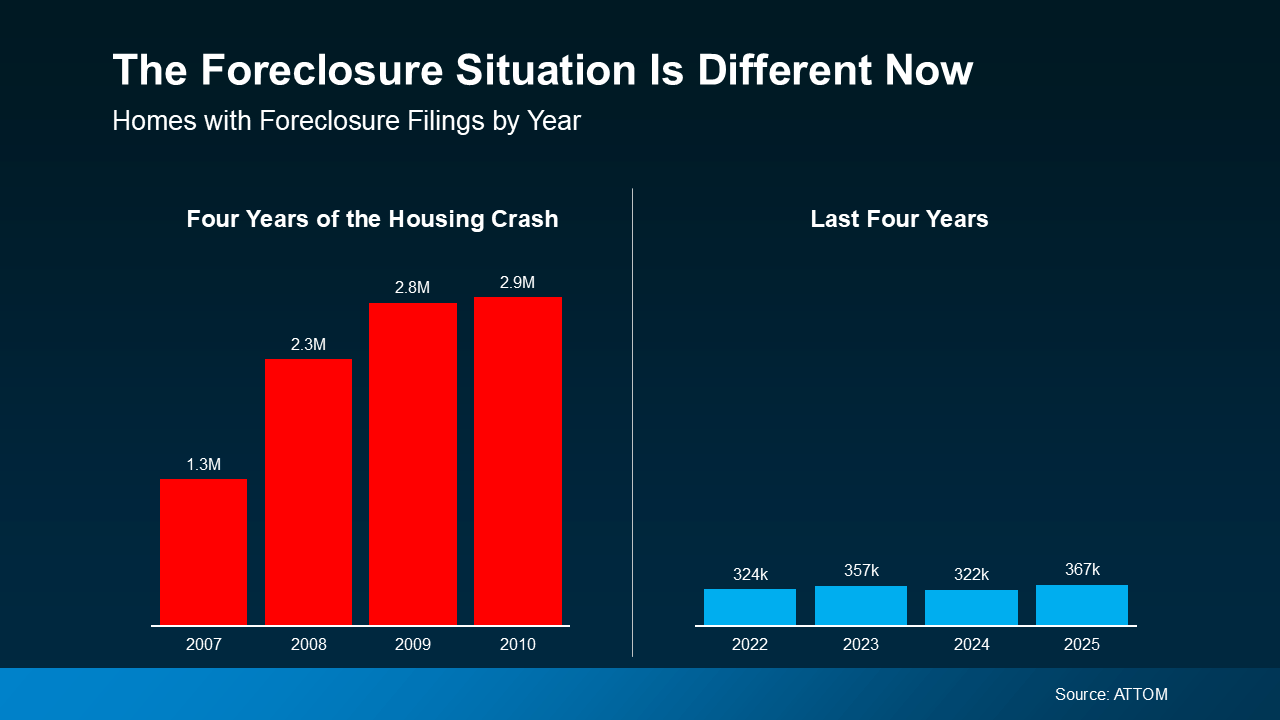 Even with the uptick lately, we are still nowhere near crash levels – far from it. This isn’t a return to crisis levels. What it is, is a return to normal.
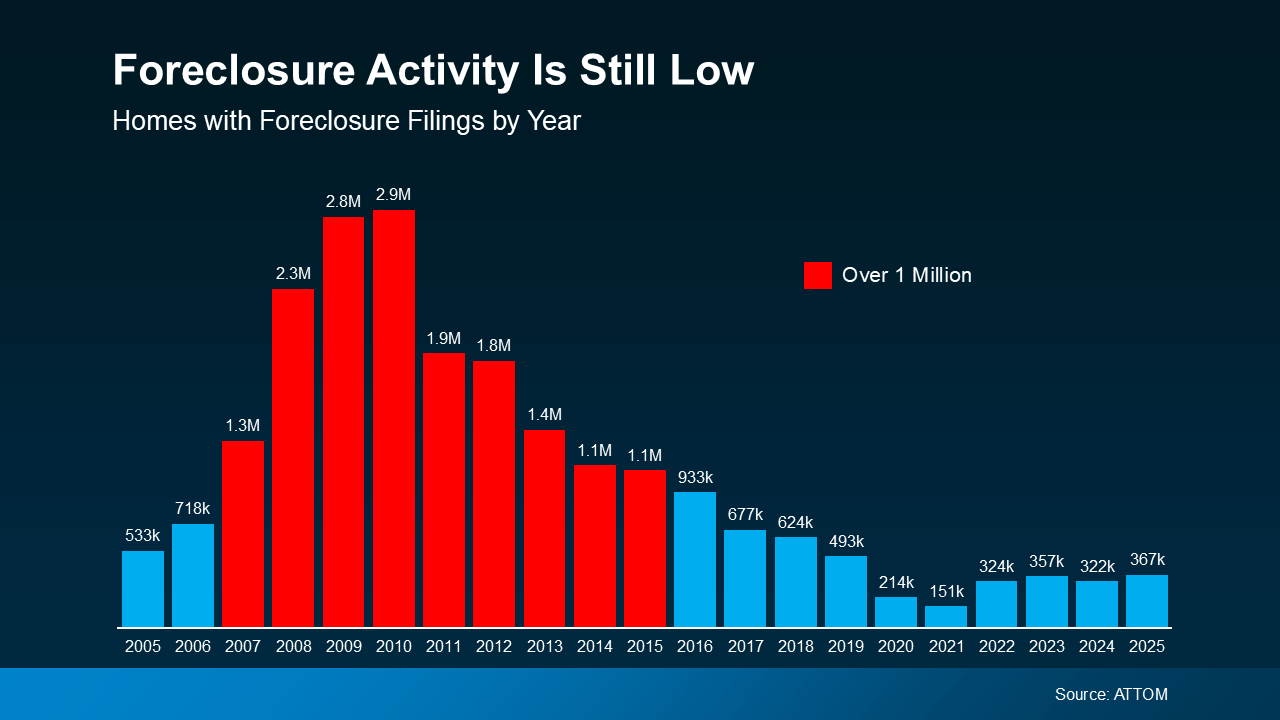
The graph below shows foreclosure filings going all the way back to early 2005. The lead up to, and the aftermath of, the crash is there in red. Those are the years when foreclosure filings went above the 1 million mark each year.
Now, look at the right side and scan back to the 2017–2019 range (the last truly normal years for housing). You’ll see we’re actually just starting to fall back in line with what’s typical for the market, even with the increase lately:
 Rob Barber, CEO at ATTOM, explains it well:
“Foreclosure activity increased in 2025, reflecting a continued normalization of the housing market following several years of historically low levels . . . While filings, starts, and repossessions all rose compared to 2024, foreclosure activity remains well below pre-pandemic norms and a fraction of what we saw during the last housing crisis . . . today’s uptick is being driven more by market recalibration than widespread homeowner distress, with strong equity positions and more disciplined lending continuing to limit risk.”
The word “normalization” in that quote is extra important. While economic and financial pressures are putting a strain on some homeowners, this isn’t a flood of distressed homes. No matter what the headlines may have you believe, this isn’t a large-scale crisis.
Today’s increase isn’t a sign of trouble. It’s a return to normal.
Why This Isn’t a Repeat of 2008
Even though the last housing crash still shapes how a lot of people interpret today’s news, the reality is, this is a different market:
- Lending standards are stronger
- Borrowers are more qualified
- And homeowners have far more equity
And that equity piece is especially important. Over the last five years, home prices have risen significantly. For many people, their house is worth far more than they paid for it. That means most homeowners have a strong financial cushion to fall back on, if needed.
Basically, if someone faces hardship today, they often have the option to sell, and maybe even walk away with money in their pocket, instead of going through foreclosure. That’s a major contrast to 2008, when many homeowners owed more than their home was worth.
Bottom Line
Foreclosure activity may be rising, but it’s still well within a normal range – and nowhere close to the danger zones of the past. But the headlines are doing more to terrify than clarify. And that’s exactly why having a trusted real estate expert you can call on is so important.
When you hear something in the news or see something on social about housing that worries you, please reach out so you have the context to understand what’s really happening and how it impacts you (if at all).
Home Updates That Actually Pay You Back When You Sell

Planning to sell this spring? While you may be tempted to hold off until the first blooms or the spring showers hit, that’s actually waiting too long to get started by today’s standards.
Buyers have more options than they did a few years ago. So, it’s worth it to tackle repairs now and make sure your house is set up to stand out. Because you don’t want to be caught scrambling right before the spring rush. Or, running out of time to do the work your house really needs.
The key is focusing on updates that actually matter. And that’s exactly where return-on-investment (ROI) data comes in handy.
Which Projects Tend to Pay Off?
Every year, Zonda looks at which home improvements deliver the most bang for the buck when you go to sell the home. And the results can be a little surprising.
The green in the chart below shows the updates where sellers have the biggest potential to add value based on that research:
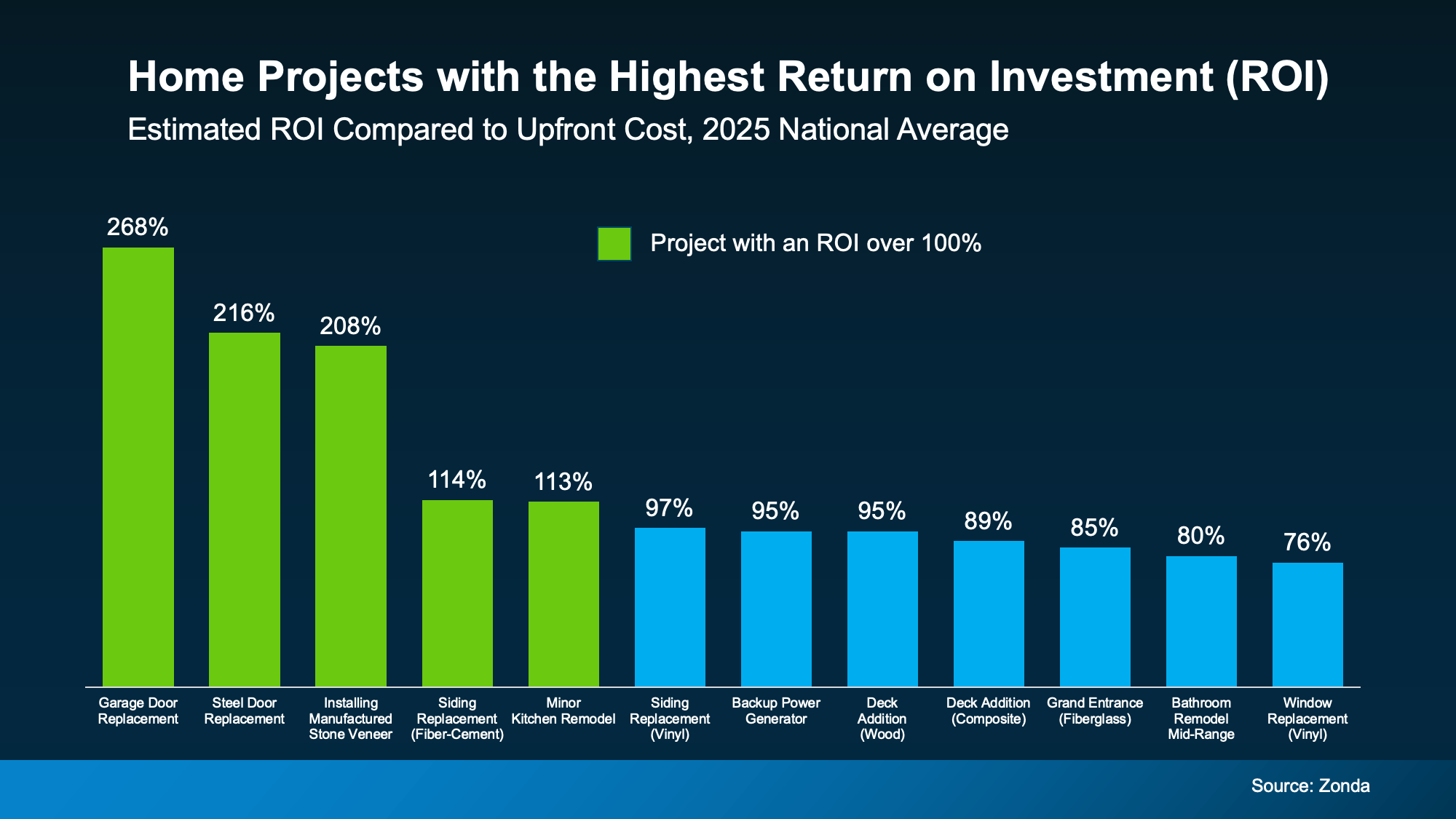 While there’s a wide range of projects represented in this data, the cool part is, some of the top winners aren’t big to-do’s. They’re just swapping out doors.
Small Updates, Big Visual Impact
This goes to show little projects can have a big impact. So, you don’t have to spend a fortune. And you don’t need to tackle everything on this list. But in today’s market, doing nothing can work against you.
Now that buyers have more homes to choose from, a lot of them are going to opt for what’s move-in ready.
The best advice? Focus on what your house needs, whether it’s listed here or not – like the repairs you’ve been putting off. A front door or shutters in need of a little TLC. Piles of leaves in the yard. Scuffed up paint where your kids play inside. Those details matter too.
Mallory Slesser, Interior designer and Home Stager, explains it to the National Association of Realtors (NAR) this way:
“If you’re looking for affordable updates that pack a punch, dollar for dollar, I would say painting; changing out light fixtures; changing out hardware; maybe new draperies or window treatments. Those are all cost-effective ways to make a big statement. It really changes the space.”
These seemingly small things help buyers focus on the home itself – not the work they think they’ll have to do after moving in. And that’s paying off for other sellers. Buyers are often willing to spend more on homes that feel well cared for, updated, and move-in ready.
This Chart Is a Starting Point, Not a Strategy
Here’s the important thing to remember. National data like this is a guideline. Buyer preferences are going to vary by location, price point, and even neighborhood. That means a project that boosts value in one area might be unnecessary (or even overkill) in yours.
That’s why the first step should always be to talk with a local real estate professional before you start.
An experienced agent can help you answer questions like:
- Which updates do buyers in your market expect?
- What can you skip without hurting your sale?
- Where will a small investment make the biggest difference?
- Is it better to update, or sell as-is?
That guidance helps you avoid over-improving and under-preparing.
Bottom Line
If you’re looking to sell this spring, you still have time to make updates that help your home stand out – without taking on a full renovation.
If you’re not sure where to start, let’s talk through what makes sense for your house. A quick conversation can help you prioritize the updates that’ll pack the biggest punch.
What’s one upgrade you’ve been thinking about – and wondering if it’s worth it?
Are Big Investors Really Buying Up All the Homes? Here’s the Truth.

It’s hard to scroll online lately without seeing some version of this claim:
“Big investors are buying up all the homes.”
And honestly, if you’re a homebuyer who’s lost out on a few offers, that idea probably sounds believable. When homes are expensive and competition is tight, it’s easy to assume giant companies are scooping everything up behind the scenes.
But here’s the thing: what people assume is happening and what the data actually shows aren’t always the same.
Let’s look at what’s really happening with large institutional investors in today’s housing market – because the numbers tell a much different story than the headlines.
The Number Most People Won’t See Online
Let’s start with the most important stat. According to John Burns Research & Consulting (JBREC), large institutional investors – those that own 100 or more homes – made up just 1.2% of all home purchases in Q3 of 2025 (see graph below):
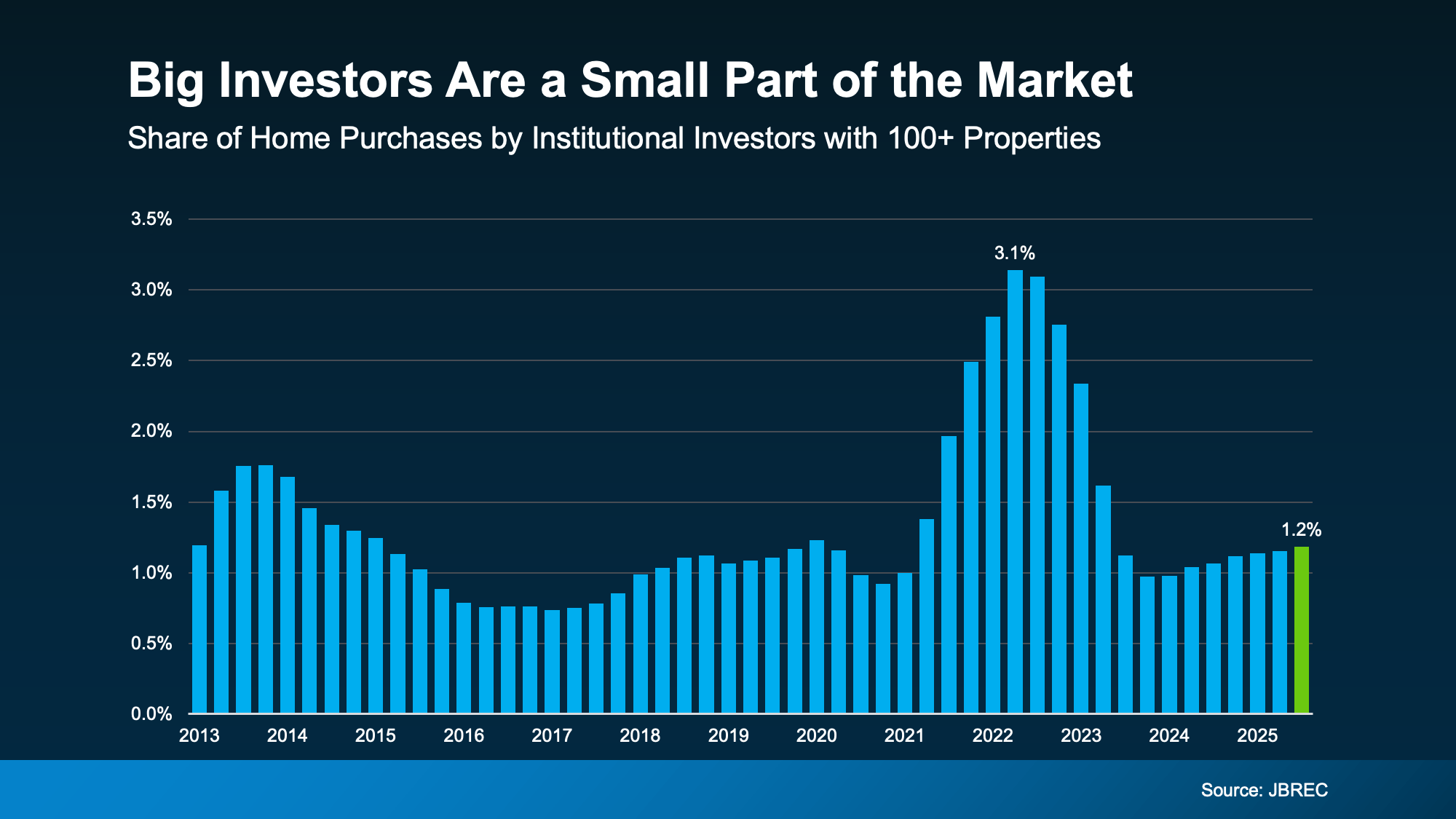 That’s it. Out of every 100 homes sold, only about 1 went to a large institutional investor.
And here’s an important point that often gets missed: that level of investor activity is very much in line with historical norms. It’s not unusually high, and it’s actually well below the recent peak of 3.1% back in 2022 – which itself was still a small share of the overall market.
So, while it can feel like big investors are everywhere, nationally, they’re a very small part of overall home sales.
Why Investor Activity Gets So Much Attention
There are two main reasons this topic gets so much attention:
- Investor activity isn’t spread evenly.Investors are more active in certain markets, which can make competition feel intense for homebuyers in those areas. As Lance Lambert, Co-Founder of ResiClub, explains:“On a national level, “large investors”—those owning at least 100 single-family homes—only own around 1% of total single-family housing stock. That said, in a handful of regional housing markets, institutional and large single-family landlords have a much larger presence.”
- Investor is a broad term.Part of what makes the share of purchases bought by investors sound so big is because many headlines lump large Wall Street institutions together with small, local investors (like your neighbor who owns one or two rental homes). But those are very different buyers.In reality, most investors are small, local owners, not massive corporations. And when all investors get grouped together in the headlines as a single stat, it inflates the number and makes it seem like big institutions are dominating the market (even though they’re not).
Yes, big investors exist. Yes, they buy homes. But nationally, they’re responsible for a very small share of total purchases – far smaller than most people assume.
The bigger challenges around affordability have much more to do with supply, demand, and years of underbuilding than with large institutions competing against everyday buyers.
That’s why it’s so important to separate noise from reality, especially if you’re trying to decide if now is the right time to move.
Bottom Line
If you want to talk through what investor activity actually looks like in our local market, and how it impacts your options (or doesn’t), let’s connect.
Sometimes a little context makes all the difference.
The #1 Regret Sellers Have When They Don’t Use an Agent
Want to know the #1 thing homeowners regret when they sell without an agent? It’s that they didn’t price their house correctly for their current market.
According to the latest data from the National Association of Realtors (NAR), those sellers agree pricing their home effectively was the hardest part of the process.
Top 5 Most Difficult Task for Sellers Who Didn’t Use an Agent:
- Getting the price right
- Preparing or fixing up the house
- Selling within the desired time frame
- Handling all the legal documents
- Finding the time to manage all aspects of the sale
And that makes sense. Pricing isn’t as simple as picking a number from an online estimate or copying what your neighbor got last year. It takes real insight into:
- What buyers are actually willing to pay today
- How much competition you have in your area
- What similar homes nearby are really selling for
- How desirable your area or neighborhood is
- The condition of your house
Without that context, it’s easy to overshoot the mark, especially now that buyers can be more selective. And in today’s market, that’ll backfire.
Overpricing Isn’t a Small Mistake, It Snowballs
Your price is part of what shapes a buyer’s first impression. And when it’s too high, a chain reaction begins.
If buyers think you’re asking too much, they’re going to turn the other way. And when buyers bypass your house, you’ll get fewer showings. Fewer showings lead to fewer offers. And fewer offers usually mean making a price cut to try to draw buyers back in.
And that’s happening a lot lately, especially on homes sold without a pro.
The same NAR report shows most homes sold without an agent (59%) had to reduce their asking price at least once (see the orange in the graph below).
 The Part Sellers Don’t See Coming
 The Part Sellers Don’t See Coming
The trouble is, price cuts don’t always fix the problem. They can attract bargain hunters rather than strong, confident buyers. That’s because many buyers see a price drop as a sign there’s something wrong with the house. And that assumption can turn buyers away too.
By the time your house finally sells, you may net less than if you’d priced it correctly from the start. Again, the data backs this up.
NAR shows that homes sold with an agent sell for nearly 8% more than homes sold without one.
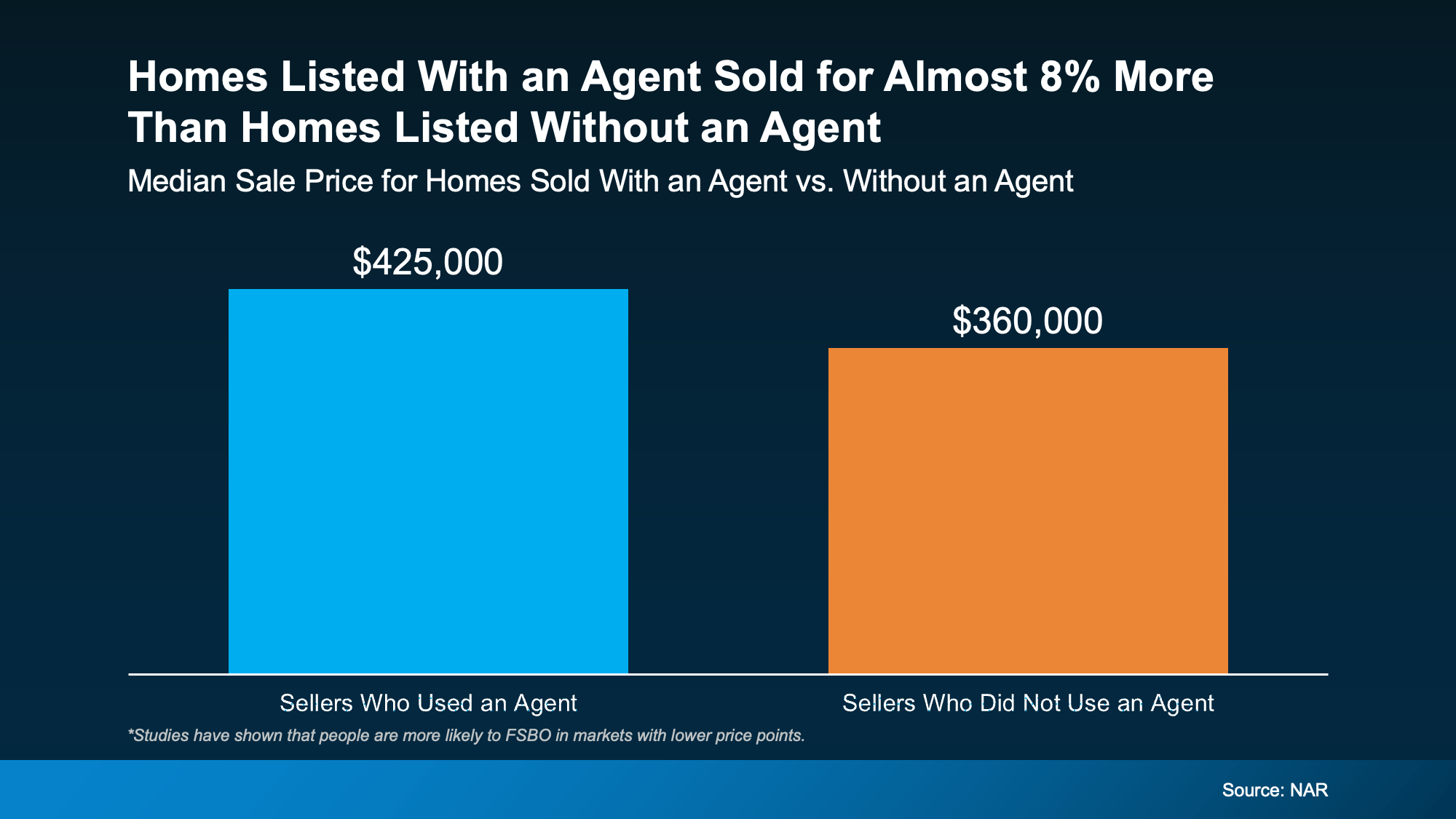 That’s not because agents magically add value. It’s because they have the expertise needed to get it right. The price. The prep. The presentation. And the paperwork.
Nail all of that from day one, and you’ll be set up to get as much money as you can out of your sale.
So, even though you thought selling without an agent meant saving money, that’s not necessarily true. The facts show selling on your own can mean selling for less in the long run. And that may be enough to totally change your perspective.
Bottom Line
Today, the biggest risk of selling without an agent isn’t the paperwork or the hassle. It’s the price. And once pricing goes wrong, it’s hard to course correct.
So, if you’re thinking about selling and want to understand what your home would realistically go for in our market today, let’s connect. A quick pricing conversation now can save you from bigger regrets later.
Expert Forecasts Point to Affordability Improving in 2026
Wondering what to expect from the housing market in 2026? You’re not the only one. For the past few years, affordability has been the biggest barrier standing between most people and their next move. And a lot of buyers and sellers have been holding their breath waiting for things to get better. The good news? It’s finally happening.
In 2025, affordability was the best it’s been in 3 years. And experts agree the momentum will keep going in 2026. And that’s based on their analysis of the key factors shaping the housing market in the year ahead: mortgage rates, inventory, and home prices.
Lower Mortgage Rates Are Already Here
Mortgage rates have already come down from their peak. By some counts, they dropped by almost a full percentage point over the course of the last year. And that’s a big deal, even if it doesn’t sound like it. But how low will they go? And should you wait for them to come down more? Here’s your answer.
Forecasts suggest they’ll stay pretty much where they are now and hover in the low 6% range throughout 2026 (see graph below):
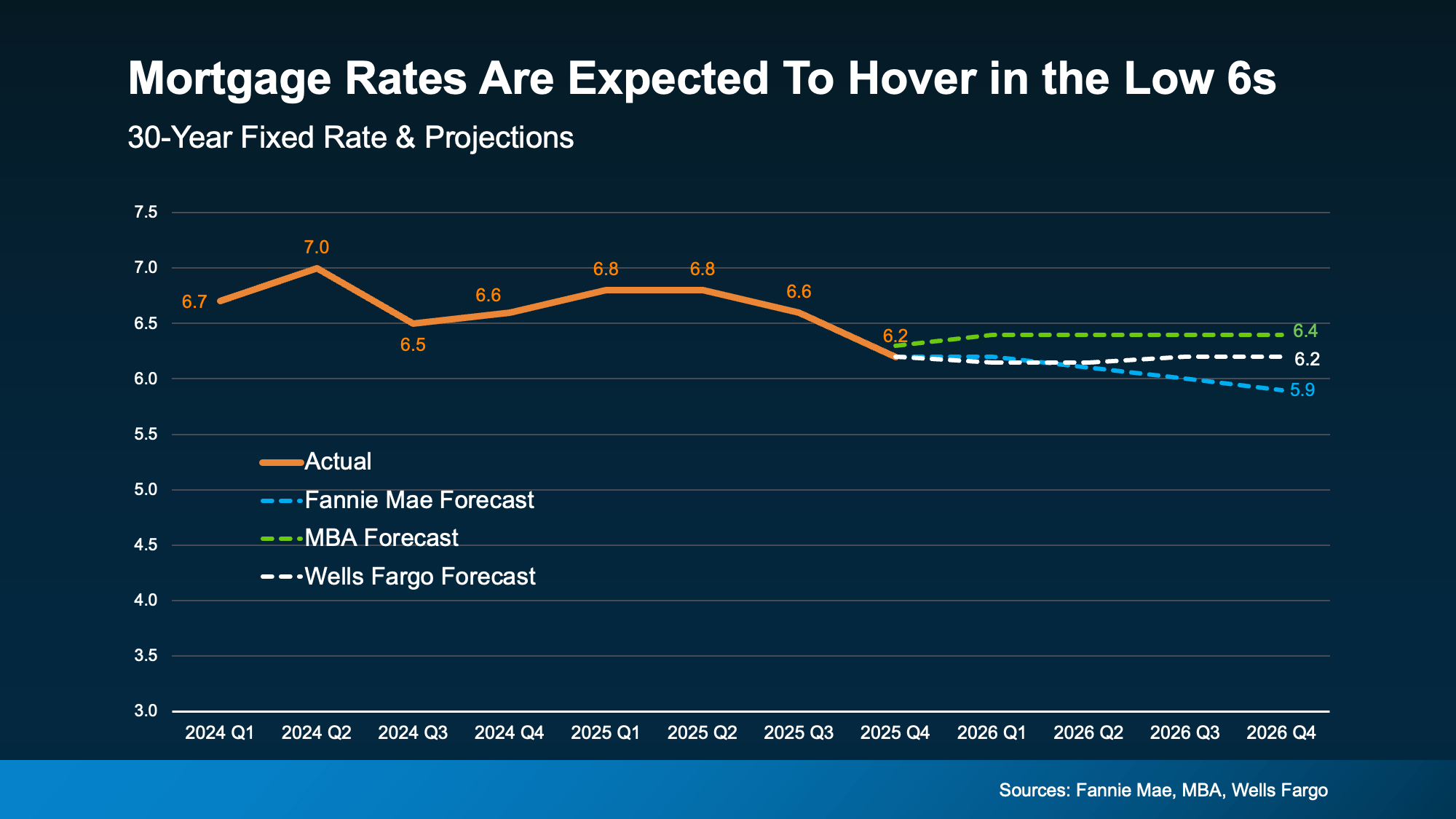 Where they go from here really depends on what happens with the economy, the job market, and any changes in monetary policy the Fed makes in the year ahead. The important thing is, they’re already lower than they were just one year ago and that’s ideal if you’re planning a 2026 move.
- For buyers: A lower rate reduces monthly payments and increases buying power. And, that combo helps more people qualify for homes that previously felt just out of reach.
- For sellers: It may be time to accept that rates in the 6s are the new normal. And if you need to move, it’s doable, especially with your equity.
Even More Options Are on the Way
In 2025, the number of homes for sale improved by about 15%. As inventory rose, buyers regained things they hadn’t had in years: options, time to consider those options, and negotiating leverage. That helped restore more balance to the housing market.
Not to mention, the inventory gains are a big piece of what’s helped price growth slow down – which in turn improves affordability.
While the inventory gains this year aren’t expected to be as steep, experts at Realtor.com say the supply of homes for sale should grow by another 8.9% this year.
- For buyers: That means even more choice and more negotiating power.
- For sellers: Pricing your house right will be essential to draw in buyers.
Home Price Growth Is Slowing to a More Sustainable Pace
With more homes for sale, there isn’t as much upward pressure on prices right now. And we’ve seen that shake out over the past year. Even so, the overwhelming majority of experts say, nationally, prices will continue rising in the year ahead – just at a slower pace. On average, they say prices will rise by 1.6% in 2026 (see graph below):
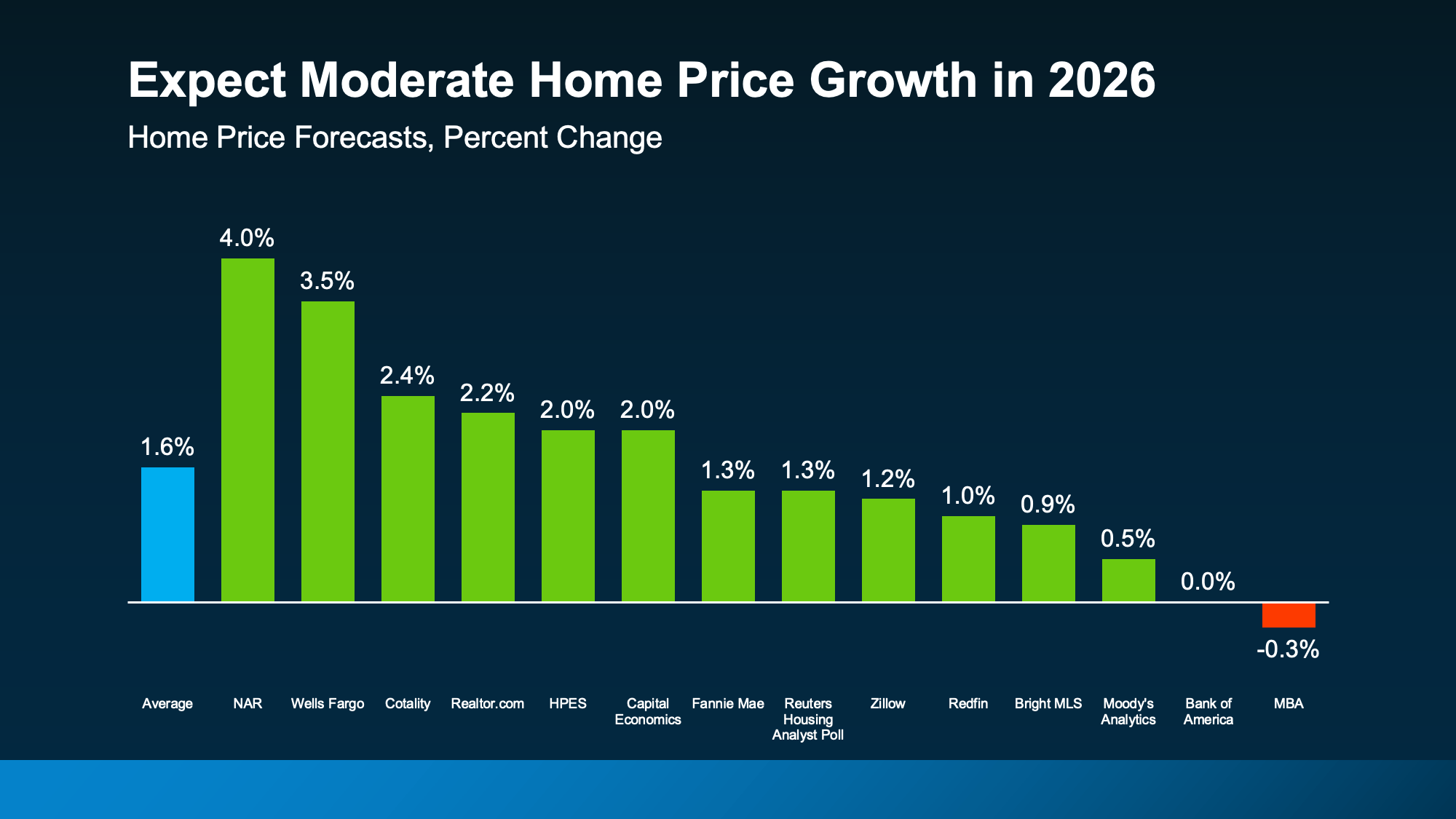 And that’s reassuring if you’ve been fed content on social media saying prices are going to come crashing down. But here’s what you need to remember most about this. It’s going to vary a lot by area.
So, lean on a local agent for the latest on what’s happening where you are. Some markets will see prices rise more than this. Others may see prices come down slightly. It really all depends on conditions in your local market
But overall, prices will continue to rise at the national level. And that’s good for the market as a whole. As Realtor.com explains:
“For homebuyers and sellers, the shift signals a more balanced market—one where price growth steadies, rate relief offers breathing room, and negotiating power tilts subtly toward buyers.”
- For buyers: Expect more moderate price growth, not the sudden and intense spikes just a few short years ago. That gives you fewer surprises and more predictability, which makes budgeting a whole lot easier.
- For sellers: This slower price growth restores balance without putting your equity at risk. And that’s a win.
More Homes Will Sell
All of this adds up to a better affordability equation in 2026. And that’s exactly why experts are saying we should see more homes sell (and more people buy) this year.
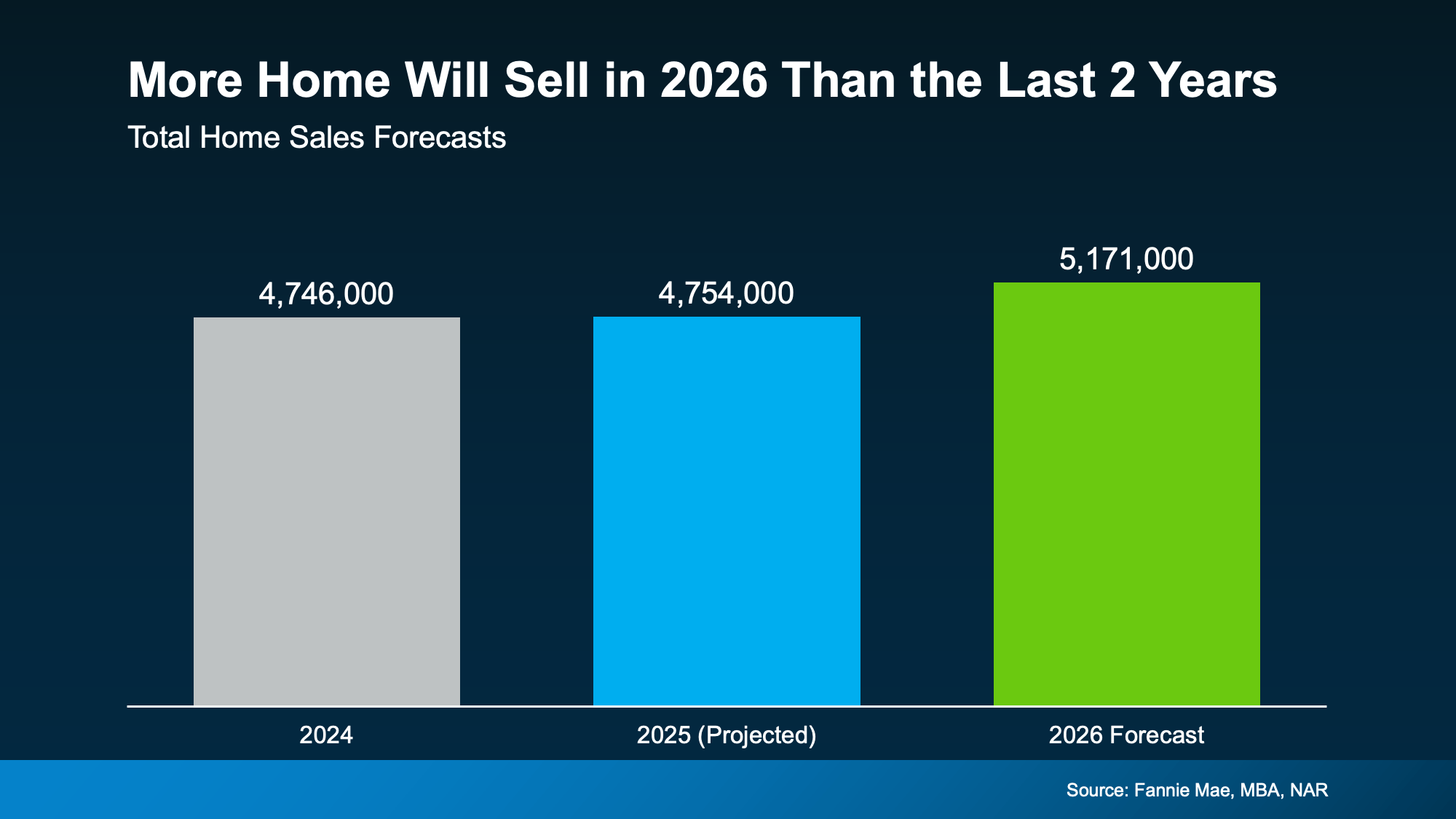 As Mischa Fisher, Chief Economist at Zillow, says:
“Buyers are benefiting from more inventory and improved affordability, while sellers are seeing price stability and more consistent demand. Each group should have a bit more breathing room in 2026.”
The bottom line is, more people are finally going to be able to make their move this year. So, the question is: will you be one of them? The market is giving you an opportunity you haven’t had in a while. Maybe it’s time to take advantage of it.
Bottom Line
Affordability won’t change suddenly overnight. But, with several key trends working together, it should slowly and steadily improve in the months ahead.
That’s exactly why, in 2026, you should see a market with more balance, more predictability, and more breathing room than you’ve had in years.
Want more information about the opportunities unlocking in our local market?
Let’s chat.
The Credit Score Myth That’s Holding Would-Be Buyers Back

Would-be homebuyers aren’t sitting on the sidelines because they don’t want to buy. They’re sitting out because they think they can’t. And sometimes, it’s their credit score that’s holding them back.
According to a Bankrate survey, 2 out of every 5 (42%) Americans believe you need excellent credit to qualify for a mortgage. That may be why, when renters are asked why they don’t own yet, “my credit isn’t good enough” comes up often.
Maybe you’re in the same boat. You look at your score, see it’s not where you want it to be, and assume buying your first place just isn’t realistic right now.
But here’s what you need to know.
Even though a lot of people assume you need flawless credit to buy a house, that’s not necessarily the case.
You Don’t Need Perfect Credit To Buy a Home
So, where’s this myth come from? Part of the confusion stems from the fact that the typical homebuyer today does have a fairly strong credit score. In fact, according to data from the NY Fed, the median credit score for all buyers is 775.
But that doesn’t mean you need a score that high to qualify.
Looking at recent homebuyers, a number were able to get a mortgage with scores below that threshold. Data shows 10% of scores were around 660. Which means some were higher than that and some were lower, but the median in that lowest 10th percentile was around that range (see graph below):
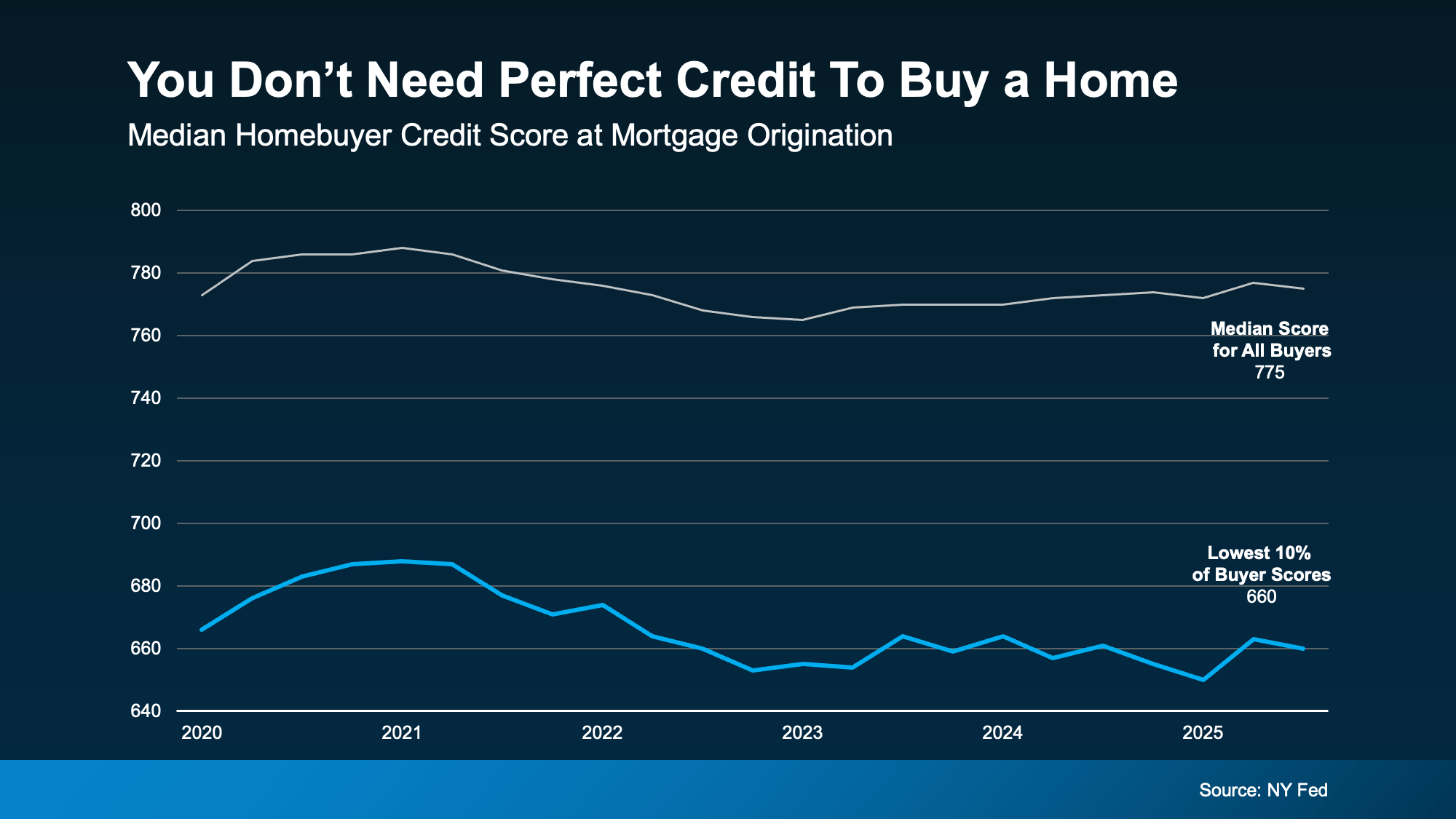 So, even if your score isn’t as high as you want, that doesn’t automatically close the door. FICO explains there is no universal credit score you absolutely have to have when buying a home:
“While many lenders use credit scores like FICO Scores to help them make lending decisions, each lender has its own strategy, including the level of risk it finds acceptable. There is no single ‘cutoff score’ used by all lenders, and there are many additional factors that lenders may use . . .”
The best thing to do is to talk to a trusted lender to see what’s possible for you. Because a portion of buyers are buying with scores in the 600s – and maybe that means you can too.
Bottom Line
Your credit score is important. But that doesn’t mean it has to be perfect.
If credit has been the reason you’ve been waiting to buy a home, it might be time to take another look at your options. If you want help understanding where you stand and what your next step could be, connect with a local lender.
You don’t need to have everything figured out to start the conversation.


