

 Facebook
 X
X
 Pinterest
 Copy Link
Why Your Home Equity Still Puts You Way Ahead

If you’ve seen headlines about home prices dropping, it’s easy to wonder what that means for the value of your home too. Here’s what you really need to know.
Even with small price declines in some markets, data shows you’re likely still way ahead. And that’s thanks to your home equity.
The Relationship Between Home Prices and Equity
Home equity moves in sync with home prices. When prices rise, equity builds. When prices cool (even just slightly), equity growth does too. Here’s how that’s played out lately.
After the record-setting home price surge of 2020 and 2021, a little cooling was inevitable.
Back then, the number of homes for sale hit a record low. That caused home values (and your equity) to shoot up significantly as buyers fought over limited inventory.
But prices couldn’t continue to rise at that intense pace forever. The market had to moderate at some point, and that’s exactly what we’re seeing right now.
As more homes have come on the market this year, price growth slowed – so, equity gains did too. And that doesn’t mean you’ve lost ground.
Putting it into Perspective
You probably still have far more equity than you did just a few years ago. And that puts you in a strong position if you want to sell. Here’s the data to prove it.
According to research from Zillow, home prices have risen a staggering 45% nationwide since March of 2020. That’s a big jump.
And in the majority of markets, prices are still rising, just at a much slower pace. But even in the metros where prices are experiencing the biggest declines (the ones making the headlines), the average drop is only about -4%.
So, what’s that really mean? In most places, prices are on the rise, so this isn’t even a concern. But in the few metros where prices are cooling off a bit, the 5-year gains more than offset those small dips.
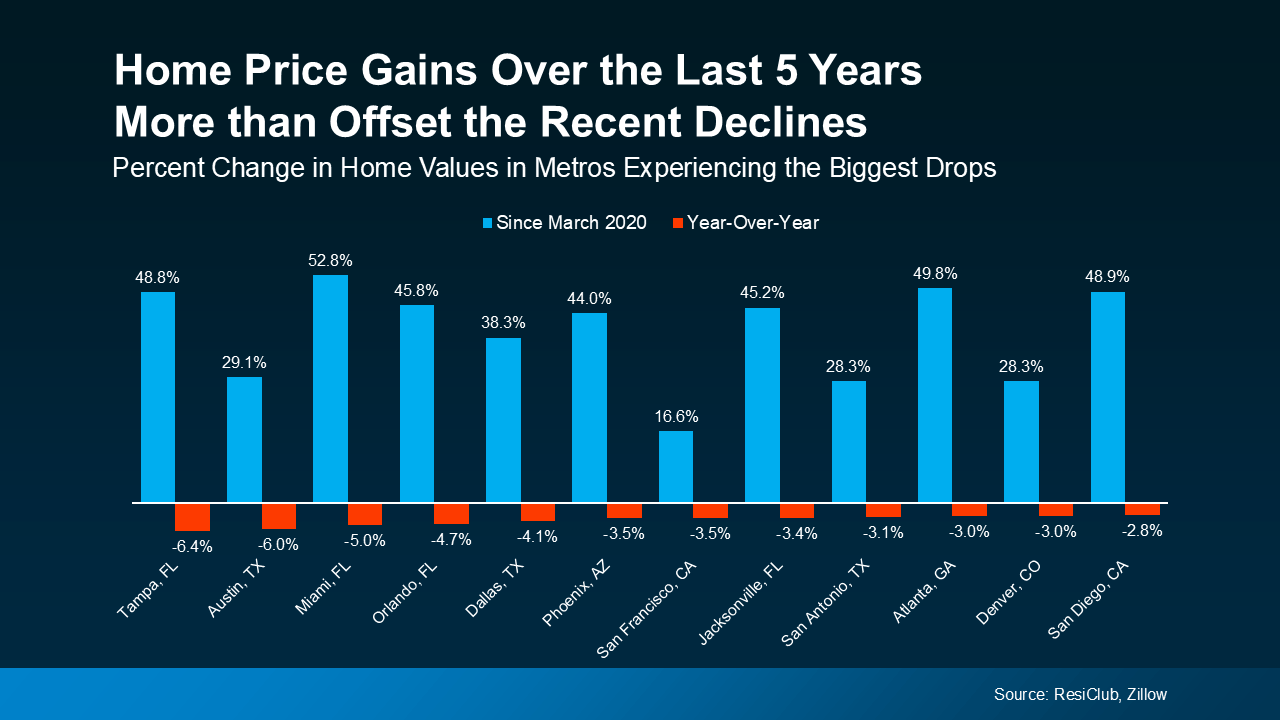 In other words, these modest declines can’t erase years of growth. Homeowners who’ve been in their houses for several years are still way ahead. Big time. And that’s true pretty much everywhere.
Data from the Federal Housing Finance Agency (FHFA) helps paint this picture. Let’s cast a slightly wider net and look at a state-by-state level this time. Every single state has seen prices go up over the last 5 years. And that means homeowners in each state have much more equity than they did just 5 years ago (see graph below):
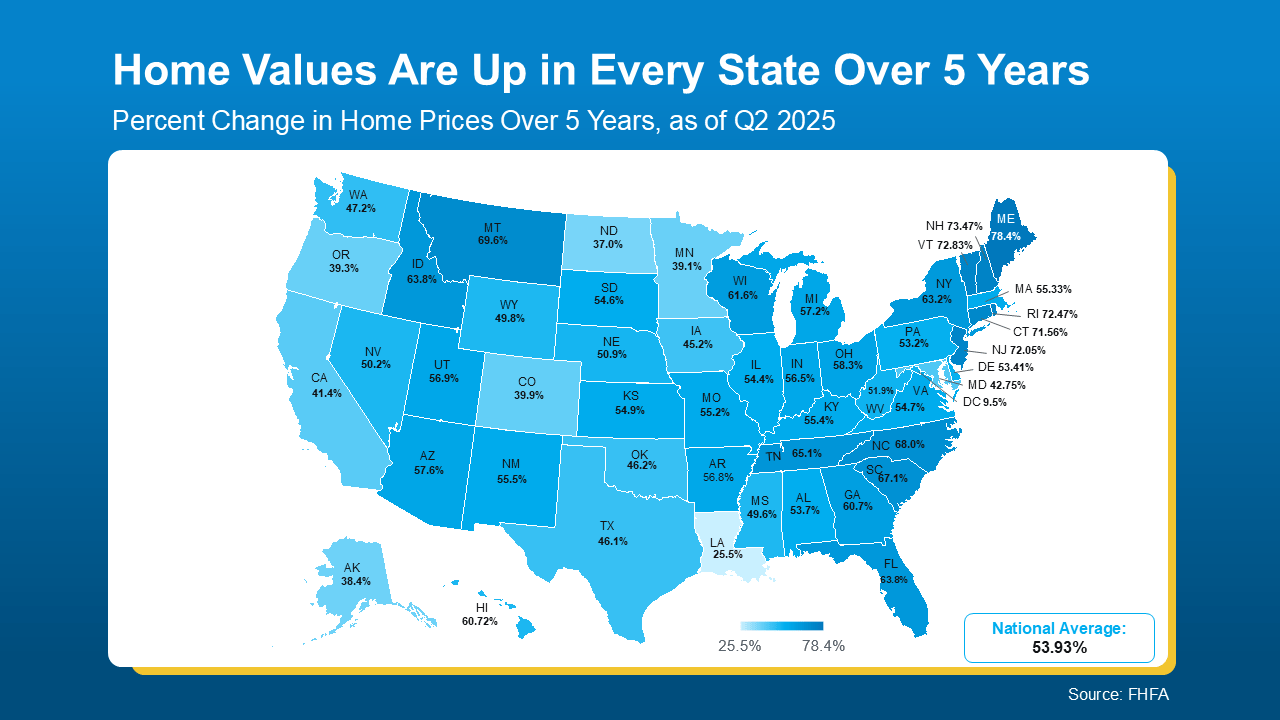 Odds are, in most places, if you’ve owned your home for more than a few years, you’ve already built the kind of equity many people could only dream about before the pandemic. And if you sell, you can use it to help you downsize, or move up.
And just in case you’re worried prices will crash and your equity will take a bigger hit in the near future, here’s what Jake Krimmel, Senior Economist at Realtor.com, has to say:
“The slight recent declines in aggregate value and total home equity are not cause for concern . . . Although the market is coming into better balance, large price declines nationally are extremely unlikely in the near term . . .”
The price moderation we’ve seen lately isn’t a cause for concern. It’s a signal of a market that’s finding its balance again after several years of unsustainable price growth. And after several years of major price appreciation, most homeowners are still in an incredibly strong position.
Bottom Line
Even with prices coming down in some markets, today’s homeowners are still sitting on near record amounts of equity.
If you’re wondering how much equity you have (or how far ahead you really are), let’s connect.
You might be surprised by what your home is actually worth today.
How To Make Sure Your Sale Crosses the Finish Line

If there was one simple step that could help make your home sale a seamless process, wouldn’t you want to know about it?
There’s a lot that happens from the time your house goes under contract to closing day. And a few things still have to go right for the deal to go through. But here’s what a lot of sellers may not know.
There’s one part of the process where some homeowners are hitting a road bump that’s causing buyers to back out these days. But don’t worry. The majority of these snags are completely avoidable, especially when you understand what’s causing them and how to be proactive.
That’s where a great agent (and a little prep) can make all the difference.
What’s Causing Some Buyers To Back Out
The latest data from Redfin says 15% of pending home sales are falling through. And that’s not wildly higher than the 12% norm from 2017-2019. But it is an increase.
That means roughly 1 in 7 deals today don’t make it to the closing table. But, at the same time, 6 out of 7 do. So, the majority of sellers never face this problem – and odds are, you won’t either. But you can help make it even less likely if you know how to get ahead.
You might assume the main reason buyers are backing out today is financing. But that’s actually not the case. The most common deal breaker today, by far, is inspection and repair issues (see graph below):
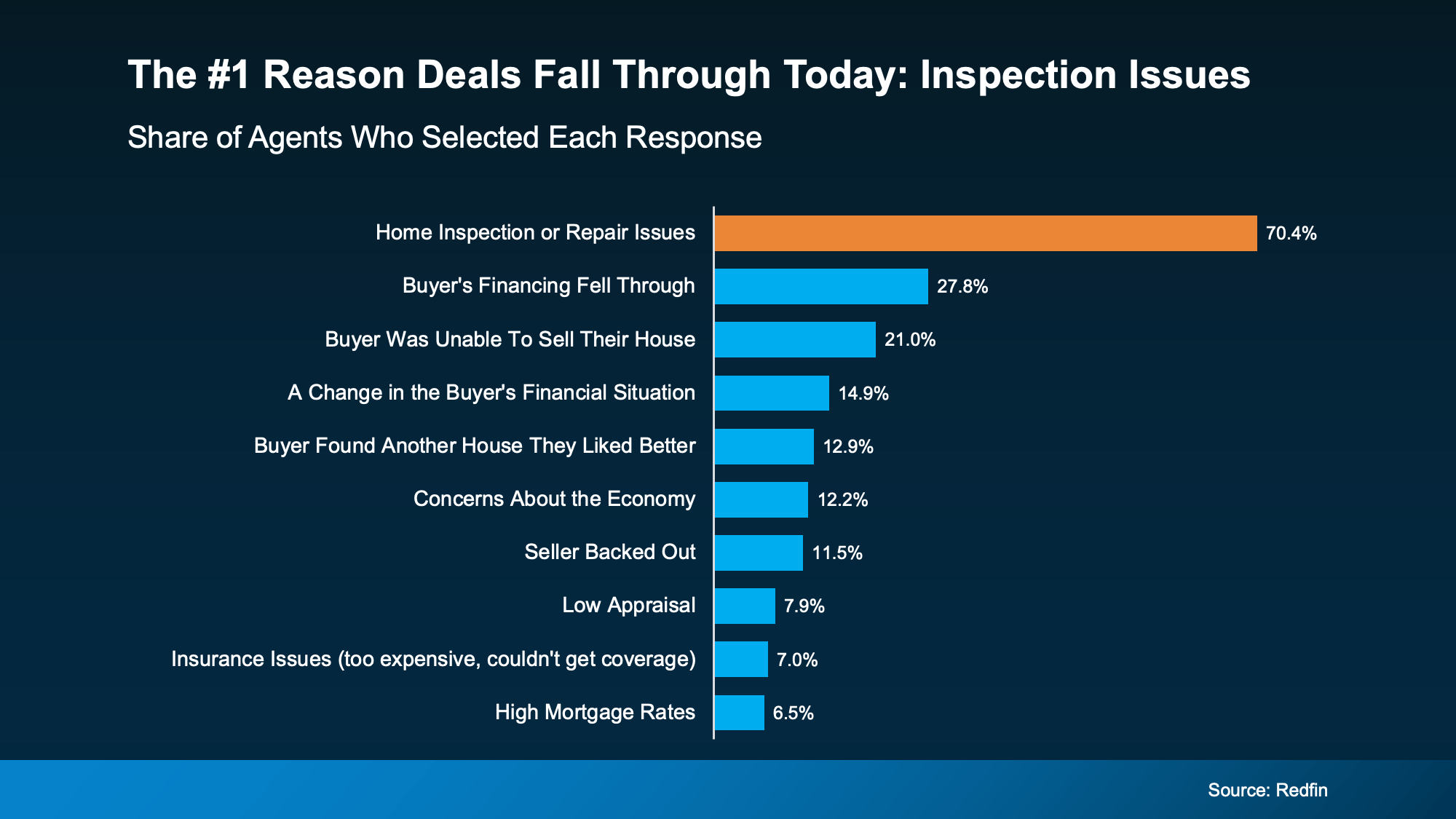 Here’s why that’s a sticking point for buyers right now:
- Buyers are already stretched thin from high prices and challenging mortgage rates, so they don’t have the appetite (or budget) for unexpected repairs.
- If they’re going to spend all that money, they want to get something that’s move-in ready. They don’t want to take on another high-cost project themselves.
- They have more homes to choose from, so if yours seems like a hassle or if you’re not willing to fix something, they can just move on.
The sellers with the best agents have heard about this shift and they’re doing what they can to go in prepared. Enter the pre-listing inspection.
What’s a Pre-Listing Inspection?
It’s exactly what it sounds like. It’s a professional home inspection you schedule before your home hits the market. And while it’s not required, the National Association of Realtors (NAR) explains why it could be a valuable step for some sellers right now:
“To keep deals from unraveling . . . it allows a seller the opportunity to address any repairs before the For Sale sign even goes up. It also can help avoid surprises like a costly plumbing problem, a failing roof or an outdated electrical panel that could cause financially stretched buyers to bolt before closing.”
Think of it as a way to avoid future headaches. You’ll know what issues could pop up during the buyer’s inspection – and you’ll have time to fix them or decide what to disclose before you put your house on the market.
This way, when the buyer’s inspector walks in, you’re ready. No surprises. No last-minute panic. No deal on the line.
Is It Worth It?
Generally speaking, a pre-listing inspection costs just a few hundred dollars. So, it’s not a big expense. And the information it gives you is invaluable. But before you make that investment, talk to your local agent.
In some markets, it may not be worth it. And in others, it may be the best move you can make. It all depends on what’s happening where you are and what’s working for other local sellers. If your agent recommends getting one, they’ll also:
- Help you decide which issues to fix
- Prioritize repairs based on what buyers in your area are focusing on
- Connect you with trusted professionals to get the work done
- Ensure you understand local disclosure laws
That small step could save your deal (and your timeline).
Bottom Line
So, if there was one simple step that could help make your home sale go according to plan, would you do it?
If you’d rather deal with surprises on your terms (not with the clock ticking under contract), let’s talk about whether a pre-listing inspection makes sense for your house.
It may be worth it so you can hit the market confident, prepared, and in control.
Thought the Market Passed You By? Think Again.

If you stepped back from your home search over the past few years, you’re not alone – and you’re definitely not out of options. In fact, now might be the ideal time to take another look. With more homes to choose from, prices leveling off in many areas, and mortgage rates easing, today’s market is offering something you haven’t had in a while: options.
Experts agree, buyers are in a better spot right now than they’ve been in quite a long time. Here’s what they have to say.
Affordability Is Finally Improving
Lisa Sturtevant, Chief Economist at Bright MLS, says affordability is finally starting to turn the corner:
“Slower price growth coupled with a slight drop in mortgage rates will improve affordability and create a window for some buyers to get into the market.”
Mortgage rates have eased from their recent highs, price growth has slowed, and that one-two combo is making homes more affordable than they’ve been in months.
There Are More Homes on The Market
And a big reason prices are easing is because there are more homes on the market. According to the latest from Realtor.com, there are 17% more homes for sale today than there were at this time last year. That means more options, less competition with other buyers, and a chance to find the space that actually works for you.
Lawrence Yun, Chief Economist at the National Association of Realtors (NAR), shares:
“Homebuyers are in the best position in more than five years to find the right home and negotiate for a better price. Current inventory is at its highest since May 2020, during the COVID lockdown.”
Take a look at the numbers.
As Yun notes, inventory is up everywhere. Compared to this time last year, every region of the country has more homes on the market than at this time last year (see graph below):
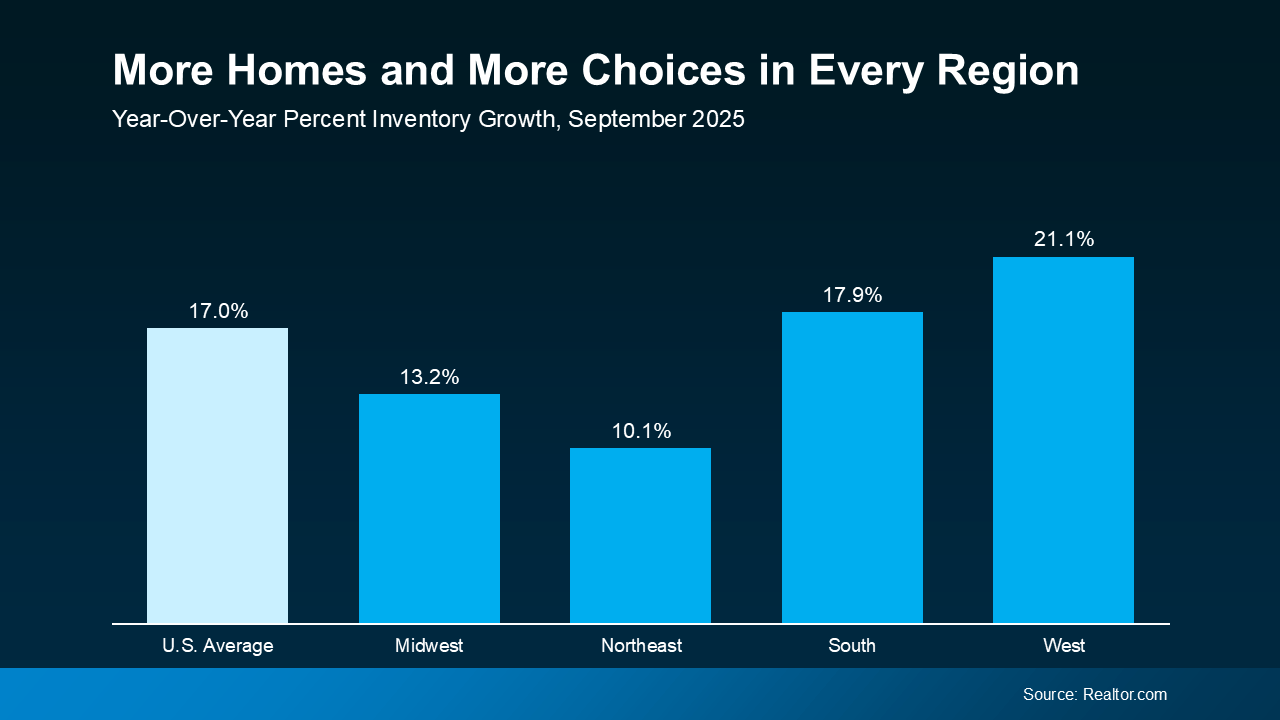 That translates to more homes to choose from, whether you’re looking for a bigger backyard, a shorter commute, or finally ditching your rental.
But not all markets are the same…
When you compare current inventory growth to pre-pandemic norms (2017–2019), the picture changes a bit, depending on where you are (see graph below):
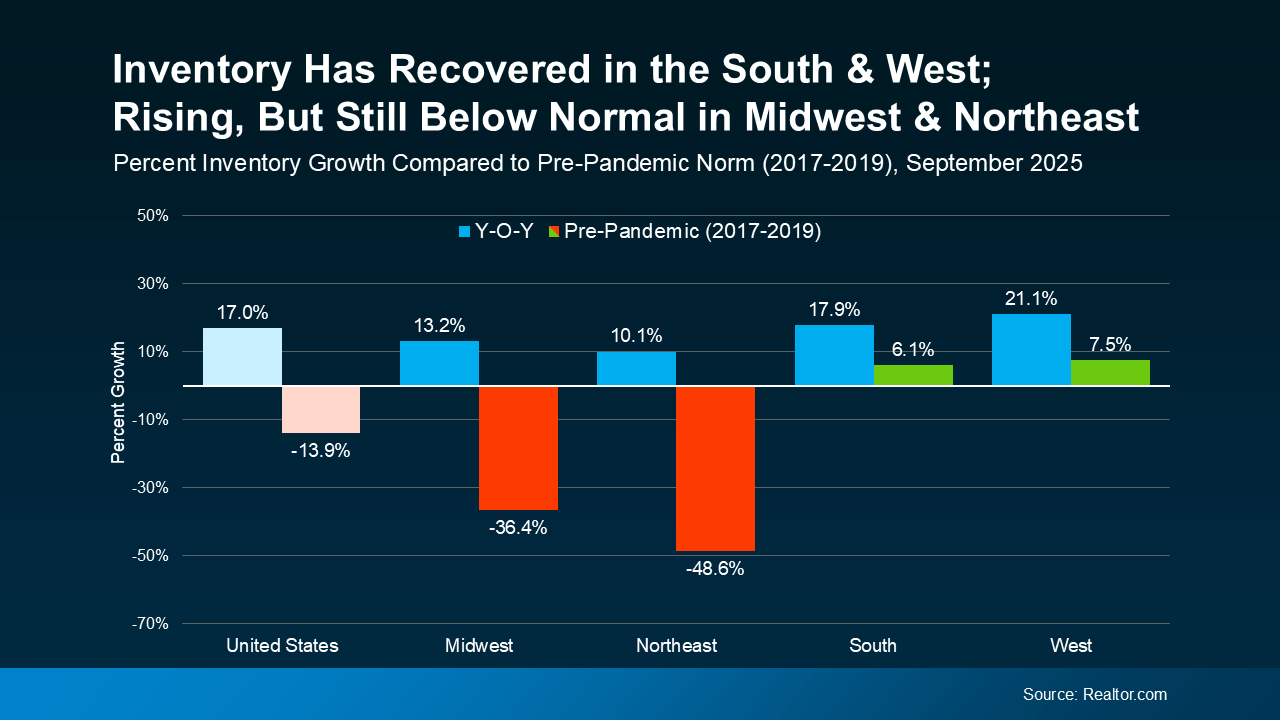 The green bars show where inventory has fully recovered (and even grown above pre-pandemic levels) in the South and the West. Supply, however, is still tighter in the Northeast and Midwest, as shown in the red bars, where inventory is still below normal.
And here’s why that’s still a win everywhere.
When you step back and look at the bigger picture, with inventory up in every region, that means more choices everywhere, even if some areas have more homes for sale than others.
And with fewer buyers in the market and more homes for sale, sellers are willing to negotiate to get a deal done.
All of that adds up to a win for today’s buyers.
And it’s also why working with a local expert really makes a difference. What’s happening in your zip code or neighborhood might look different than the national or regional trend. But the overall takeaway is clear: with more homes on the market, buyers have more leverage than they did a year or more ago.
So, if you stepped away from your search because things felt too competitive, too pricey, you were worried about finding a home, or it was all just too much to process, this could be your moment to take another look.
And if you’re not quite ready to go all in, that’s okay too. You can start by planning ahead. That means working with a trusted agent who can help you break down your budget, narrow your search, and make sure you’re prepped and ready when the right home hits the market.
Bottom Line
Want to know what’s happening in our area? Let’s have a conversation so you can get a custom overview of what’s available right now and learn how to be ready when the timing is right for you.
Because this isn’t 2021.
This isn’t even 2023 or 2024.
This is a new market – and you might be surprised by what you find.
Why You Don’t Need To Be Afraid of Today’s Mortgage Rates
Mortgage rates have been the monster under the bed for a while. Every time they tick up, people flinch and say, “Maybe I’ll wait.” But here’s the twist. Waiting for that perfect 5-point-something rate could end up haunting your wallet later.
The Magic Number
According to the National Association of Realtors (NAR):
“. . . a 30-year fixed rate mortgage of 6% would make the median-priced home affordable for about 5.5 million more households—including 1.6 million renters. If rates were to hit that magic number, it’s likely that about 10%—or 550,000—of those additional households would buy a home over the next 12 or 18 months.”
When the market hits that mortgage rate sweet spot, as expert forecasters are starting to say is more likely in 2026, the psychological shift to lower rates will kick in for more of today’s hopeful buyers. That will unleash some pent-up demand that’s been waiting on the sidelines, and the increase in activity will cause prices to rise.
And while a 5.99% rate might sound like a big win, if you’re waiting for that number to make your move, it might not actually save you as much as you think. Here’s how the math looks when you run the numbers (see chart below):
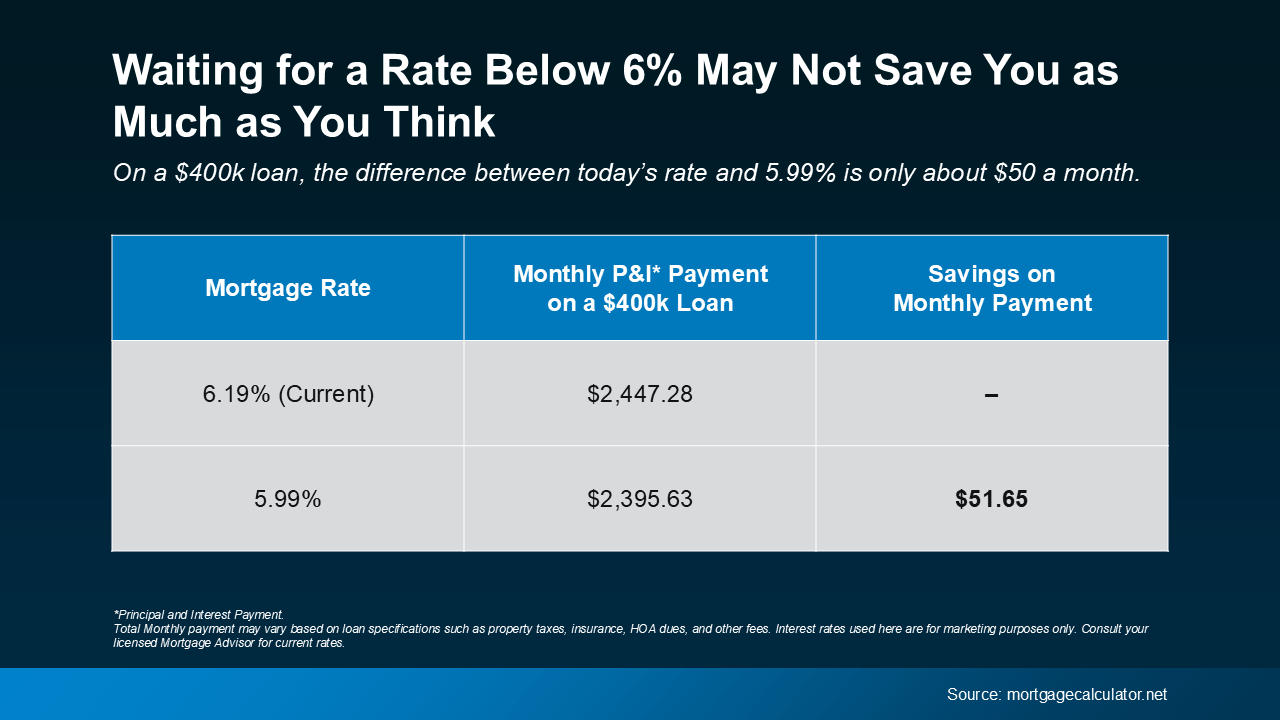 On a $400,000 mortgage, the difference between today’s rate (around 6.2%) and 5.99% is roughly $50 a month. That’s less than many people spend on weekly coffee runs or occasional DoorDash orders. And as prices tick up with more buyers in the market, that could quickly negate any of your potential savings.
So, if you’re waiting for 5.99%, that difference might not be worth missing out on today’s opportunities, like having more homes to choose from, better negotiation leverage with today’s sellers, and fewer buyers out there looking for the same houses.
Because the reality is, those benefits start to slip away when more buyers begin to make their moves – and a rate under 6% is exactly they’re waiting for.
Why Acting Now Makes Sense
Jessica Lautz, Deputy Chief Economist and VP of Research at NAR, says:
“Over the last 5 weeks, mortgage rates have averaged 6.31%. This has provided savvy buyers a sweet spot to reexamine the home search process with more inventory, widening their choices.”
And like Matt Vernon, Head of Retail Lending at Bank of America, notes:
“Rather than waiting it out for a rate that they like better, hopeful homebuyers should assess their personal financial situation—if the house is right for them, and the upfront and monthly payments are affordable, it could be the right chance to make a move.”
Bottom Line
If moving at today’s rate scares you, remember, waiting doesn’t always pay off. Once rates dip below 6%, as some experts project they’ll do next year, more buyers (and higher prices) will be back.
So, don’t be afraid of today’s mortgage rates. Because if you’re ready, this might just be your chance to make your move before the market wakes up again.
Why Some Homes Sell Quickly – and Others Don’t Sell at All
A few years ago, inventory hit a record low. Just about anything sold – and fast. But now, there are far more homes on the market. Listings are up almost 20% from this time last year. And in some areas, supply is even back to levels we last saw in 2017–2019. For sellers, that means one thing:
Your house needs to stand out and grab attention from day one.
That’s especially true when you consider why the number of homes for sale is up. Here’s how it works. Available inventory is a mix of:
- Active Listings: homes that have been sitting on the market, but haven’t sold yet
- New Listings: homes that were just put on the market
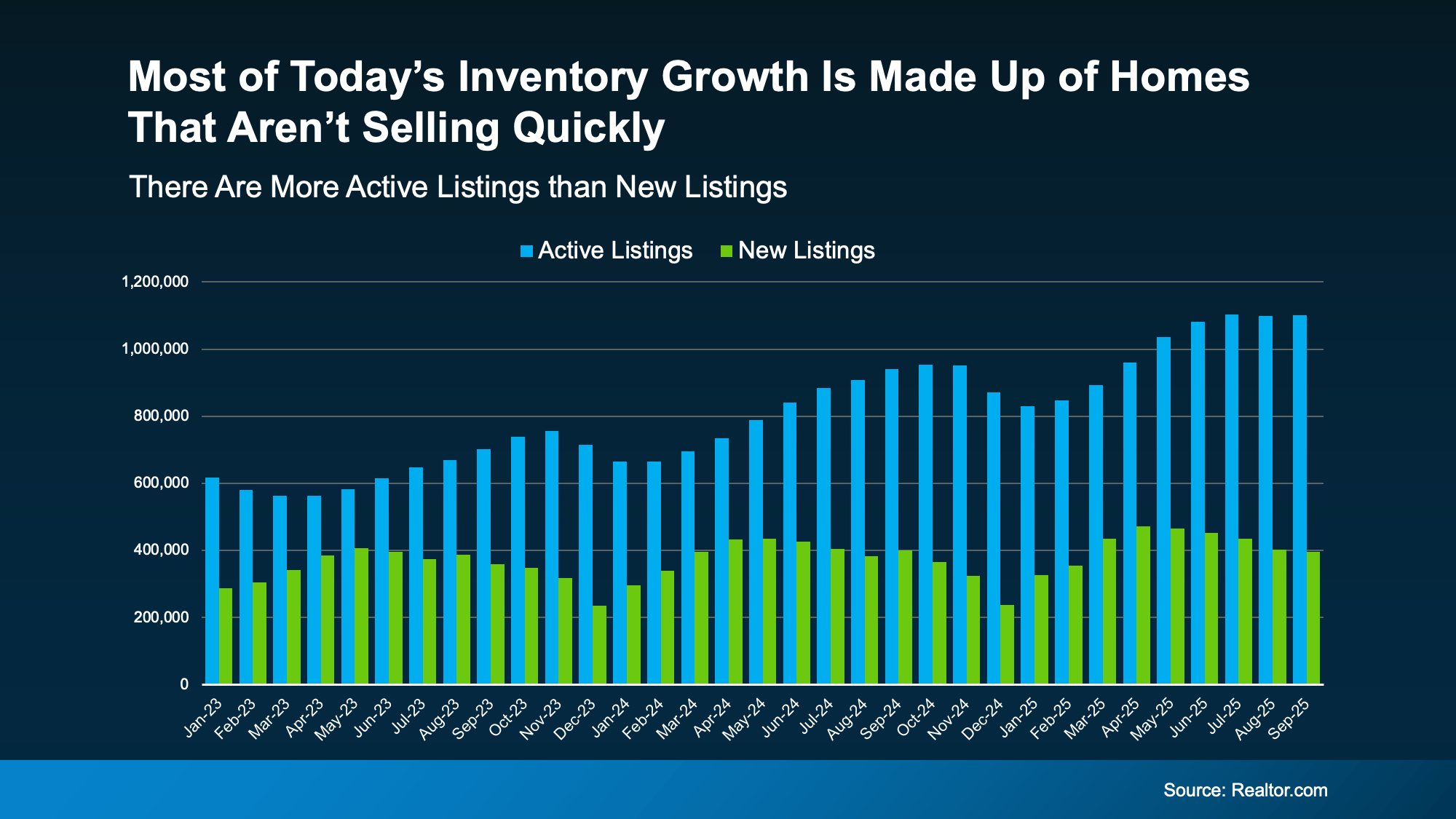
Data from Realtor.com shows most of the inventory growth lately is actually from active listings that are staying on the market and taking longer to sell (see the graph below).
The blue bars show active listings. These are the homes that are sitting month to month and not selling. The green bars are new listings, the homes that were just put on the market. And it’s clear there are fewer new listings compared to how many are staying on the market unsold.
 Since you don’t want your house to be one of the ones that take a long time to sell, let’s break down where things can go sideways and how to set yourself up to sell quickly.
Why Some Homes Sell and Others Sit
The secret to selling in today’s market is simple. Make sure your house is easy for buyers to say yes to as soon as it is listed.
Price it based on current conditions (not what your neighbor sold for 3 years ago). Make important repairs. And highlight the best things about your house. If you do that, it will sell in any market – sometimes even faster than you’d think. Because the truth is, homes that are priced right today are still selling.
It’s the homeowners who are clinging to outdated expectations that are seeing their house sit and their listing go stale. According to Redfin and HousingWire, here are some of the most common reasons sales stall out:
- Priced it too high from the start
- Skipped necessary repairs before listing
- Didn’t stage the house well
- Sellers won’t negotiate with buyers
- Limited availability for showings
- Ineffective marketing or listing pictures
Most of those things didn’t matter as much just a few years ago. When inventory was at a record low, sellers could skip the prep, name their price, and still walk away with multiple offers over their asking price.
But today’s market is different now that inventory has grown. And that means your approach needs to be different too.
You don’t want to try out old strategies and aim too high just to see what sticks. Your first few weeks on the market are everything. That’s when your listing gets the most attention – and when pricing or presentation mistakes hurt the most. Get it wrong up front and your house will sit…and sit. Get it right, and it’ll be snatched up before you know it.
The Right Agent Helps Your House Stand Out
Selling quickly isn’t about luck. It’s about knowing how to play to the market you’re in. And that’s where your agent comes in.
A great agent will analyze your local market, suggest a price based on the latest comparables sold in your neighborhood, and create a marketing plan that makes buyers pay attention from day one. They’ll also walk you through any repairs you need to make or whether you need to bring in a staging company. As the National Association of Realtors (NAR) explains:
“Home sellers without an agent are nearly twice as likely to say they didn’t accept an offer for at least three months; 53% of sellers who used an agent say they accepted an offer within a month of listing their home.”
That’s the power of getting it right (and getting expert help) from the start.
Bottom Line
There are more homes for sale today than there were even just a year ago, but that doesn’t have to work against you.
When your house is priced right, shows well, and is marketed effectively, it will sell. Let’s connect if you want to know how to make that happen in our market this fall.
The Reason Homes Feel Like They Cost So Much (It’s Not What You Think)

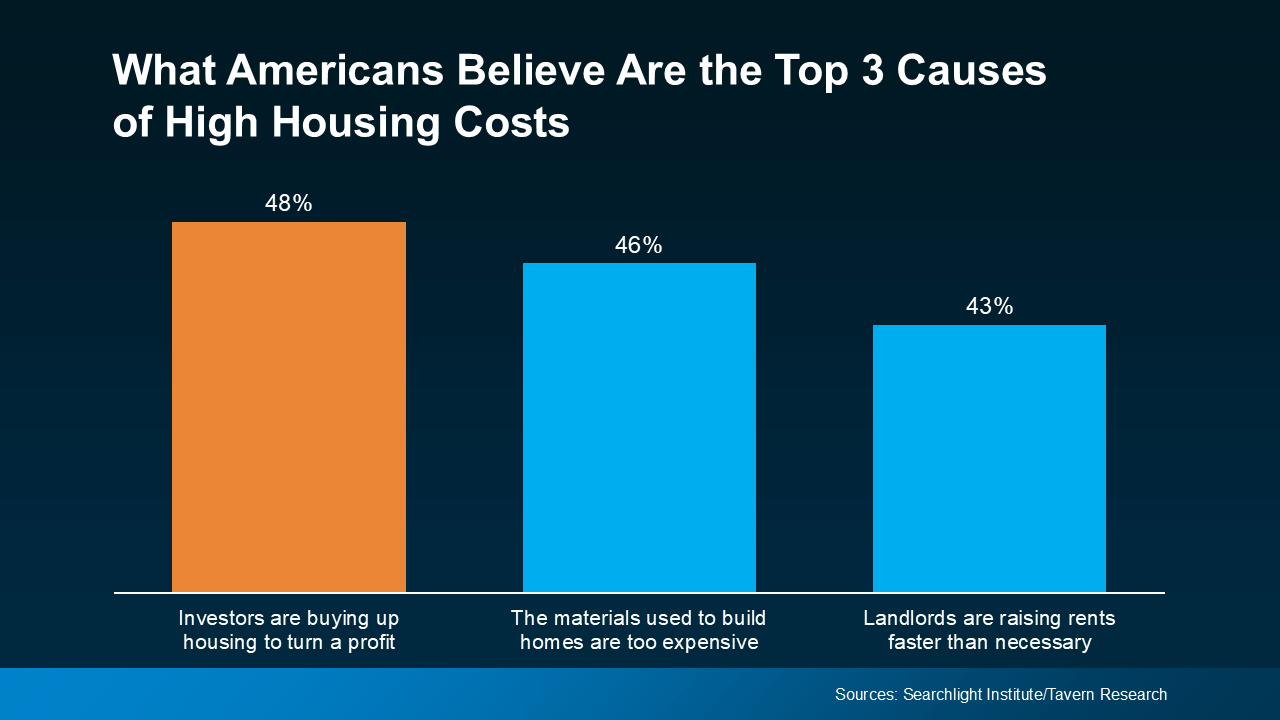
Scroll through your feed and you’ll see plenty of finger-pointing about why homes cost so much. And according to a national survey, a lot of people believe big investors are to blame.
Even though data shows that’s not true, nearly half of Americans surveyed (48%) think investors are the top reason housing feels so expensive (see graph below):
 But that theory doesn’t actually hold up once you look at the data.
The Truth About Investors
Investors do play a role in the housing market, especially in certain areas. But they’re not buying up all the homes like so many people on social media say.
Nationwide, Realtor.com found only 2.8% of all home purchases last year were made by big investors (who own more than 50 properties). That means roughly 97% of homes were bought and sold by regular people, not corporate giants. Danielle Hale, Chief Economist at Realtor.com, explains:
“Investors do own significant shares of the housing stock in some neighborhoods, but nationwide, the share of investor-owned housing is not a major concern.”
So, if it’s not investors, why are home prices so high?
What’s Really Behind Today’s Home Prices
The real story behind rising prices has less to do with who’s buying and more to do with what’s missing: enough homes. Robert Dietz, Chief Economist at the National Association of Home Builders (NAHB), says:
“It’s been popular among some to blame investors, but with housing, the economics of that don’t make a lot of sense. The fundamental driver of housing costs is the shortage itself—it’s driven by the fact that there’s a mismatch between the number of households and the actual size of the housing stock.”
There simply haven’t been enough homes for sale to meet buyer demand. And that shortage, not investor activity, is what’s pushed prices higher just about everywhere.
Bottom Line
It’s easy to believe investors caused today’s housing challenges. But the truth is, the market just needs more homes, and that’s finally starting to happen.
As more options hit the market, buying may feel a little more realistic again.
Let’s connect and talk about what’s happening in our local market.
Planning To Sell in 2026? Start the Prep Now

You’ve got big plans for 2026. But what you do this year could be the difference between a smooth sale and a stressful one. If you’re thinking of selling next spring (the busiest season in real estate), the smartest move you can make is to start prepping now. As Realtor.com says:
“If you’re aiming to sell in 2026, now is the time to start preparing, especially if you want to maximize the spring market’s higher buyer activity.”
Because the reality is, from small repairs to touch-ups and decluttering, the earlier you start, the easier it’ll be when you’re ready to list. And, the better your house will look when it’s time for it to hit the market.
Why Starting Now Matters
Talk to any good agent and they’ll tell you that you can’t afford to skip repairs in today’s market. There are more homes for sale right now than there have been in years. And since buyers have more to choose from, your house is going to need to look its best to stand out and get the attention it deserves.
Now, that doesn’t mean you have to do a full-on renovation. But it does mean you’ll want to tackle some projects before you sell. Your house will sell if it’s prepped right. And you don’t want to be left scrambling in the spring to get the work done.
Because here’s the advantage you have now. If you start this year, you’ll be able to space those upgrades and fixes out however you want to. More time. Less stress. No sense of being rushed or racing the clock.
Whether it’s fixing that leaky faucet, repainting your front door, or finally replacing your roof, you can do it right if you start now. And you have the time to find great contractors without blowing your budget or paying extra for rushed jobs.
Get an Agent’s Advice Early
To figure out what’s worth doing and what’s not in your market, you need to talk to a local agent early. That way you’re not wasting your time or money on something that won’t help your bottom line. As Realtor.com explains:
“Respondents overwhelmingly agree that both buyers and sellers enjoy a smoother, more successful experience when they start early. In fact, a recent survey reveals that, for sellers, bringing a real estate agent into the process sooner can pay off significantly.”
A skilled agent can tell you:
- What buyers in your local area are looking for
- The repairs or updates you need to do before you list
- How to prioritize the projects, if you can’t do them all
- Skilled local contractors who can help you get the work done
And having that information up front is a game changer.
To give you a rough idea of what may come up in that conversation, here are the most common updates agents are recommending today, according to research from the National Association of Realtors (NAR):
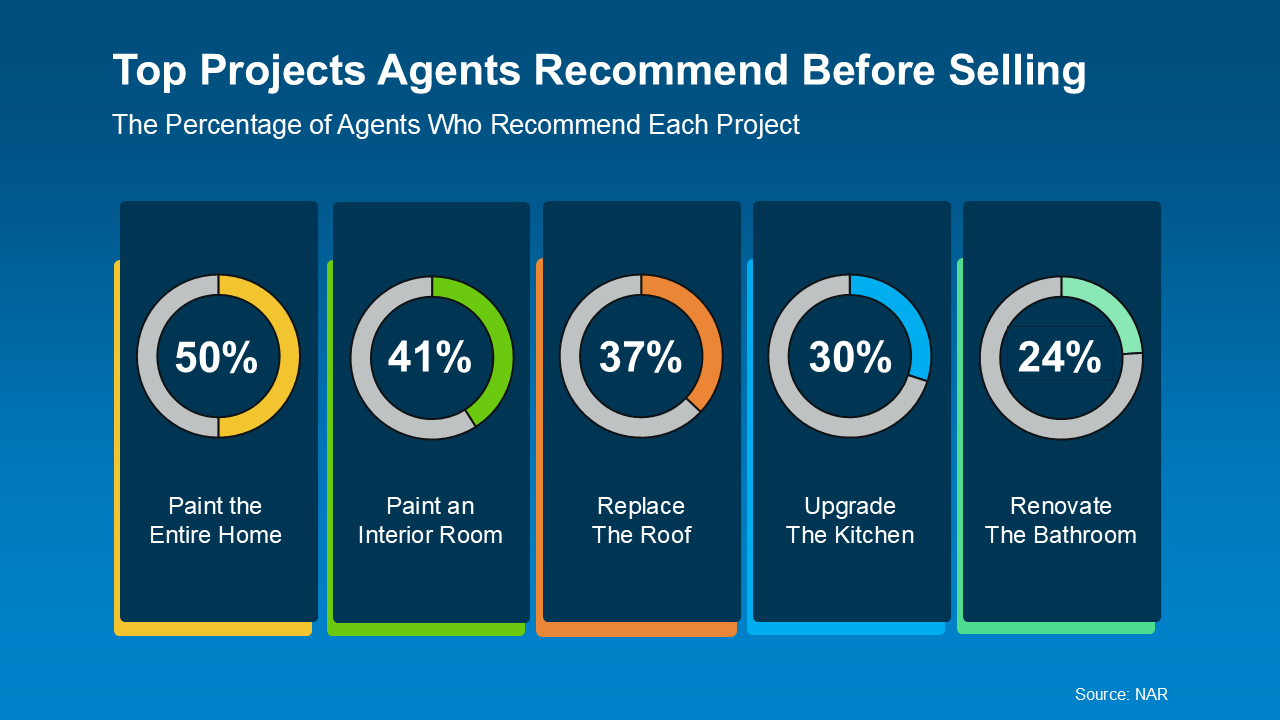 Just remember, what’s worth updating really depends on the homes you’re competing with in your market. Some areas don’t have a ton of inventory, so little updates may be all you need to tackle. In other areas, there are far more homes for sale, so you may need to do a bit more to make your house stand out.
Your agent will walk you through what you need to do for your specific house and market. And that’s expertise that’ll really pay off.
Bottom Line
If your plan is to sell in 2026, it’s time to get serious. Taking some time to prep means you’ll hit the market confident, ready, and ahead of other sellers who waited until January to get started.
Want to know which projects are getting the biggest return on their investment in our market? Let’s connect so you can head into next spring with a solid game plan.
Is the Housing Market Going To Crash? Here’s What Experts Say
If you’ve seen headlines or social posts calling for a housing crash, it’s easy to wonder if home values are about to take a hit. But here’s the simple truth.
The data doesn’t point to a crash. It points to slow, continued growth.
And sure, it’s going to vary by local area. Some markets will see prices rise more than others. And some may even see small, short-term declines. But the big picture is: home prices are expected to rise nationally, not fall, over the next 5 years.
The Real Story Is in the Expert Forecasts
In the Home Price Expectations Survey (HPES) from Fannie Mae, each quarter over 100 leading housing market experts weigh in on where they project home prices will go from here. And in the report that was just released, the experts agree prices are projected to climb nationally through at least 2029 (see graph below):
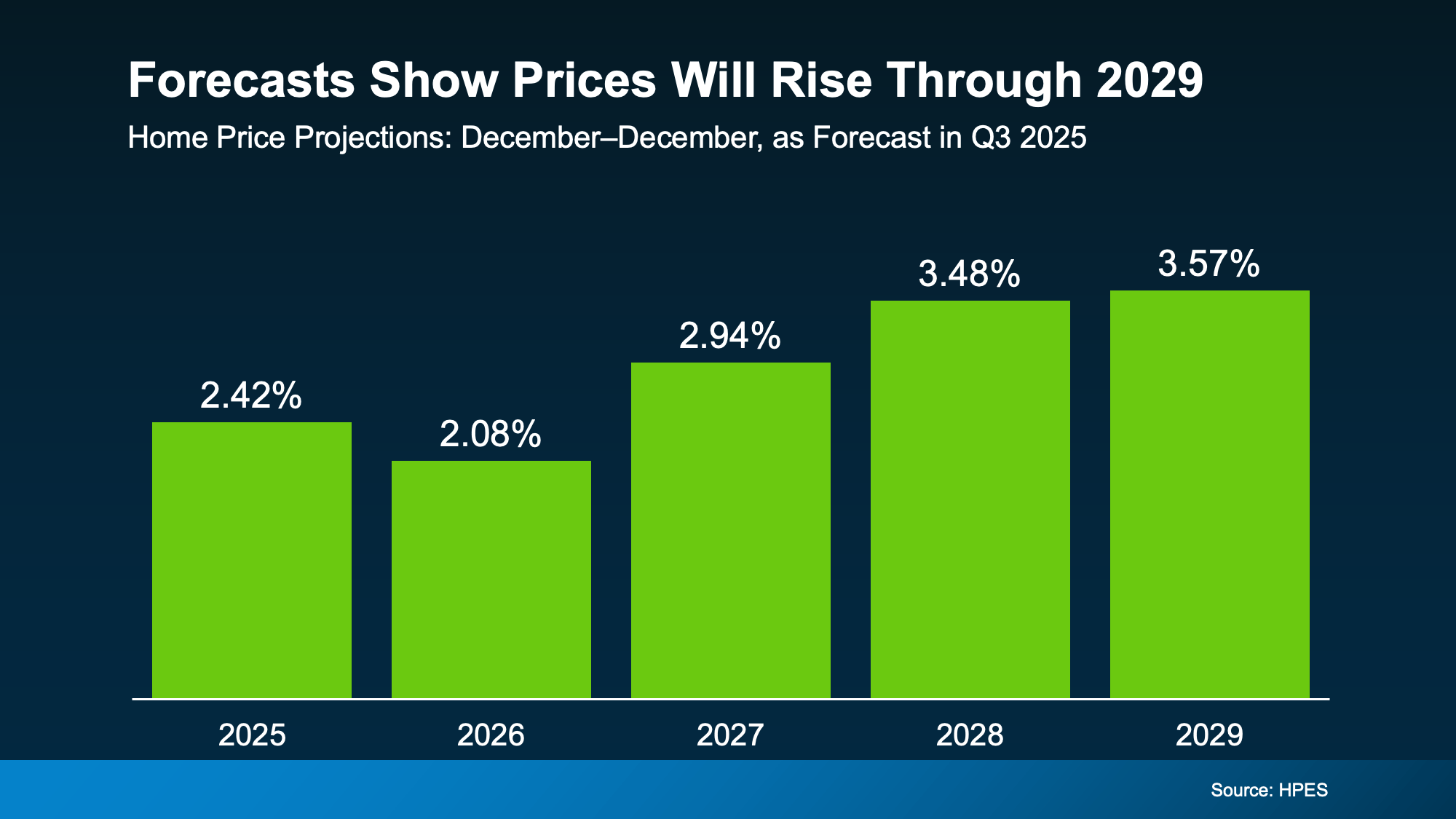 Here’s how to read this visual. Each bar in that graph shows an increase, not a loss. It’s just that the anticipated pace of that appreciation varies year-to-year.
And to further drive this home, let’s look at another view of where prices are and where they’re expected to go. In this version, the expert forecasts are broken into 3 categories: the overall average, the most optimistic projections, and the most pessimistic projections (see chart below):
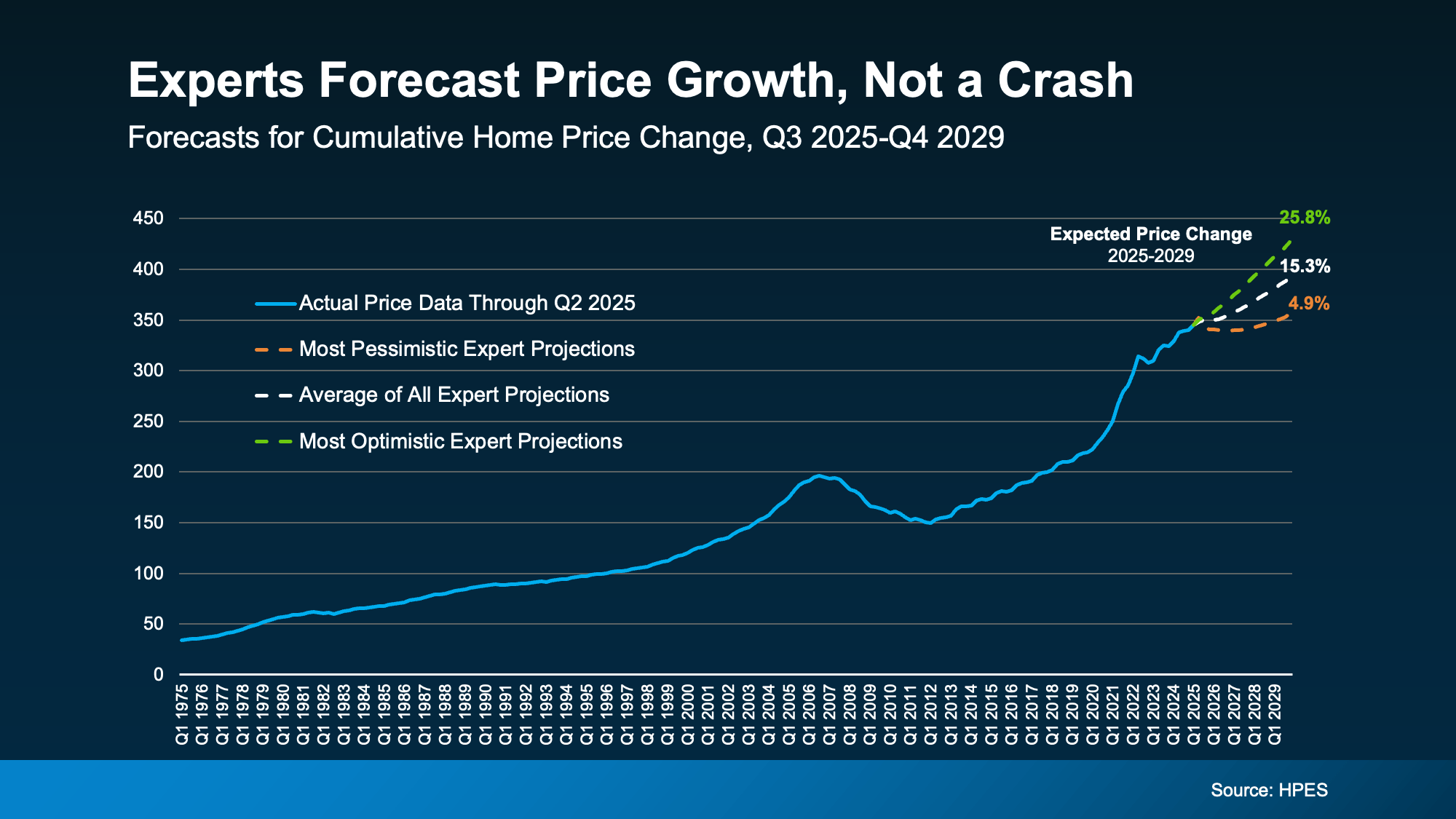 Notice how even the most pessimistic forecasters say we’ll see prices rise by almost 5% over the next few years.
- Overall, prices are expected to rise about 15% from now through the end of 2029.
- The optimists say we’ll beat that and see a roughly 26% increase.
- And even the pessimists anticipate prices will go up by 5% during that period.
What sticks out the most? None of these groups who study the market are forecasting a crash, or even a decline, over the next 5 years.
How This Compares to “Normal” for the Market
Now, focus back on the first graph. The projections call for 2-3.5% price increases in each of the next five years. For context, the average rate of appreciation for the last 25 years was closer to 4-5% annually.
So, while that’s slightly below the historical average, it’s much more sustainable and typical than where the market was in 2020, 2021, and 2022.
Back then, prices rose too much, too fast based on record-low supply and record-high demand. Some places even saw prices climb by 15-20%.
So, while it may feel like prices are stalling compared to those pandemic-era surges, what’s really happening is that the market is finally finding balance again.
Why Prices Aren’t Expected To Crash
A lot of the chatter about home prices today is based on that rapid rise and the old saying that what goes up, must come down. But historically, that’s not really true. Home prices almost always rise.
And the main reason we’re not heading for a repeat of 2008 is simple: supply and demand.
Even though affordability challenges have made it harder for some people to buy over the past few years, there still aren’t enough homes for everyone who wants one. And that ongoing shortage is keeping upward pressure on prices nationally.
That’s why experts across the board can confidently agree: we’re not headed for a price collapse, but for steady, long-term appreciation.
And just in case it’s the economy that’s got you worried, remember this. Over the past 50 years, there have been plenty of economic events that have impacted the market. And one thing that’s consistently been true throughout time is the housing market always recovers. And we’re coming through that turn right now and going into a recovery.
Bottom Line
If you’ve been waiting to buy or sell because you’re worried about a crash, it’s time to look at the data – not the headlines.
The question isn’t if home prices will rise, it’s by how much.
Let’s connect so you know what’s happening in our local market and what these forecasts mean for your next move.
The $280 Shift in Affordability Every Homebuyer Should Know

If you paused your plans to move because of high rates or prices, it may finally be time to take a second look at your numbers. Affordability is improving in 39 of the top 50 markets, according to First American. And that’s the 5th straight month where buying a home has started to get a little bit easier.
Let’s break this down into real dollars, so you can see the difference this could make for you (and your move).
Monthly Payments Are Coming Down
One of the clearest signs of this shift is in monthly payments. The latest data from Redfin shows mortgage payments on a median-priced home are now $283 lower than they were just a few months ago (see graph below):
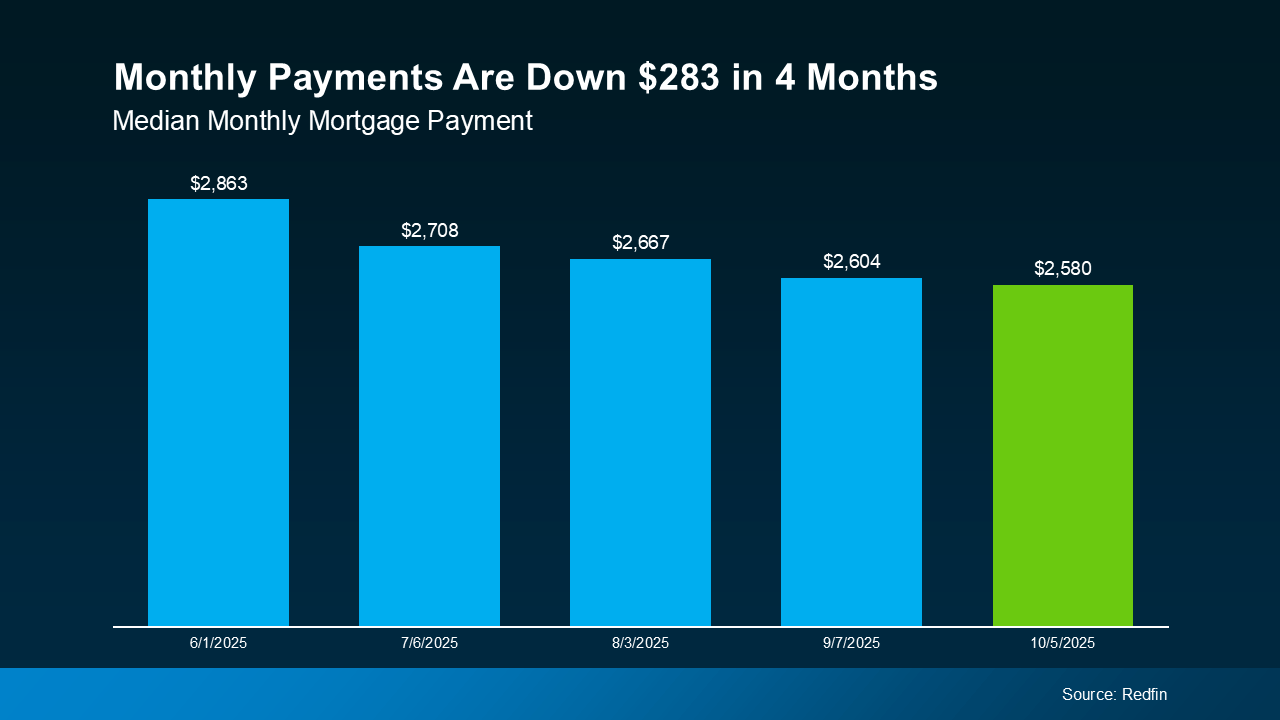 This kind of monthly savings adds up fast, and totals nearly $3,400 over the course of a year.
While this isn’t enough to completely change the affordability game overnight, think about it this way. When you’re putting together a homebuying budget, a few hundred dollars could be the difference between being comfortable buying and feeling like money’s a bit tight.
And from a home-search perspective, it could even be enough to change the price point you can look at. According to Redfin:
“A borrower with a $3,000 monthly budget can now afford a $468,000 home, about $22,000 more than in June.”
And that’s a big deal if you haven’t found a home you love in your price range yet. It gives you a little more flexibility to find the one that’s right for you.
Either way, that’s a big win.
What’s Behind the Shift?
Two key factors are working in your favor right now:
- Mortgage rates have eased from their high earlier this year
- Home price growth is slowing in many markets
Both of those things help your bottom line and give you a bit of breathing room if you’re buying a home. As Andy Walden, Head of Mortgage and Housing Market Research at ICE Mortgage Technology, says:
“The recent pullback in rates has created a tailwind for both homebuyers and existing borrowers. We’re seeing affordability at a 2.5-year high . . .”
Whether you’re a first-time homebuyer or someone looking to move-up into a bigger house, the shifts happening this year could make your move possible. Connect with a trusted agent or lender to see what your monthly payment would look like at today’s rates.
For you, the savings could be the difference between “not yet” and “let’s go.”
Bottom Line
Affordability is improving in many markets. And that resets the math on your move.
If you’ve been sitting on the sidelines, this is your cue to start looking again. Let’s run the local numbers together so you can get a rough estimate of how much more buying power you may have than you did just a few months ago.
Why More Buyers Are Turning to New Construction This Year

There’s a trend taking hold in real estate right now: more buyers are choosing newly built homes. And it’s not just about getting the latest technology or modern floorplans. It’s because they may be able to get a better deal.
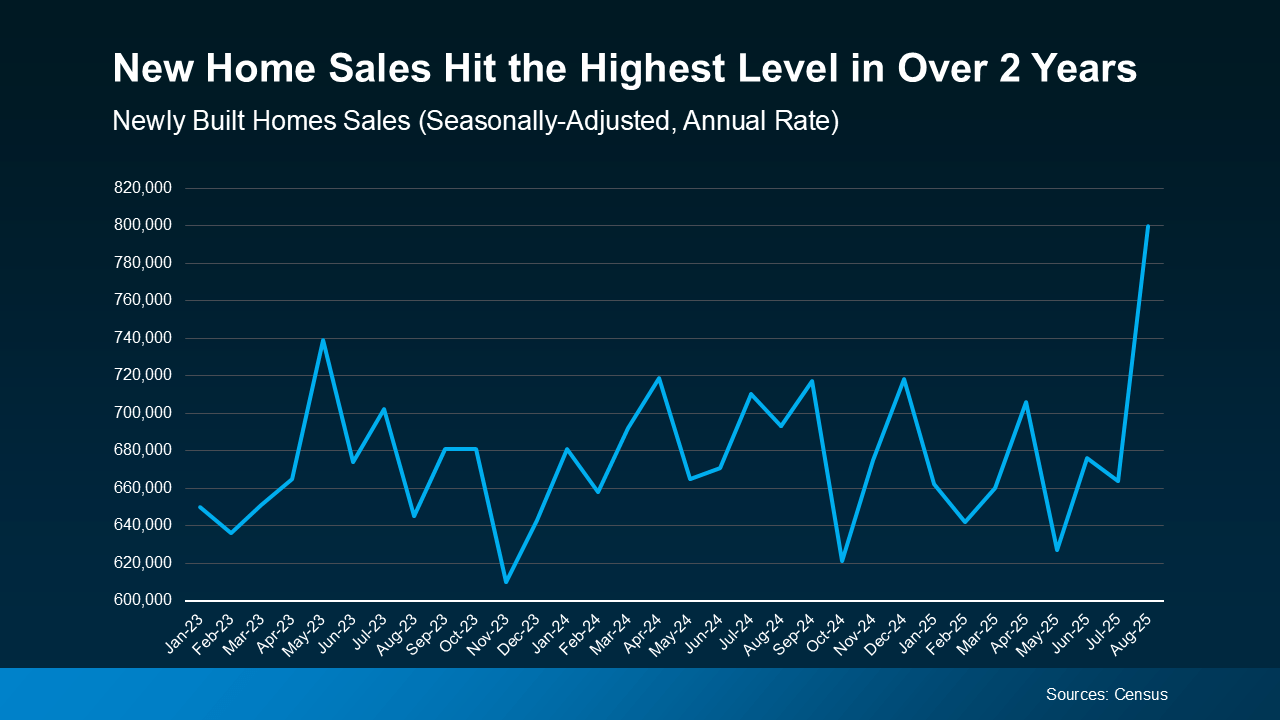
Builders are offering serious incentives today, and people are jumping on them. In fact, new home sales just hit their highest level in over two years (see graph below):
 Why Builders Are Throwing in Perks
 Why Builders Are Throwing in Perks
There are more newly built homes for sale right now than there have been in years. And as a buyer, that can help you in two big ways. It gives you more options to choose from on the market, and it motivates builders to sell their inventory before they build more.
That’s exactly why more buyers are scoring incentives like these:
- Mortgage rate buydowns to shrink your monthly payment
- Price cuts that make homeownership more attainable
- Help with closing costs and even upgrades in some communities
The best part is, a lot of builders are offering these perks right now. According to Zonda, nearly 6 out of 10 new home communities are doing incentives on to-be-built homes. And over 75% are doing the same for quick move-ins, which are homes that are already built and ready to move into. As real estate analyst Nick Gerli explains:
“. . . builders are adjusting to the realities of the current housing market. They’ve cut prices 13 percent from peak, and are giving generous mortgage rate buydowns on top of that.”
The big takeaway is: builders are motivated to sell. So, you could snag a lower price and maybe even a lower mortgage rate if you buy new. If you’ve been feeling priced out, these offers might be your way back in.
You Have More Brand-New Options Than Normal
Since there are more new homes on the market than usual, that gives you more options than you’ve had in years. Whether you’re looking for something turnkey or want to personalize a build, odds are there’s more available near you than you may realize.
Even though the number of new homes for sale is up throughout the country, there are pockets where you have an even better chance to find a better price. According to Census data, here’s a high-level look at which parts of the country are seeing the biggest boost in newly built homes (see graph below):
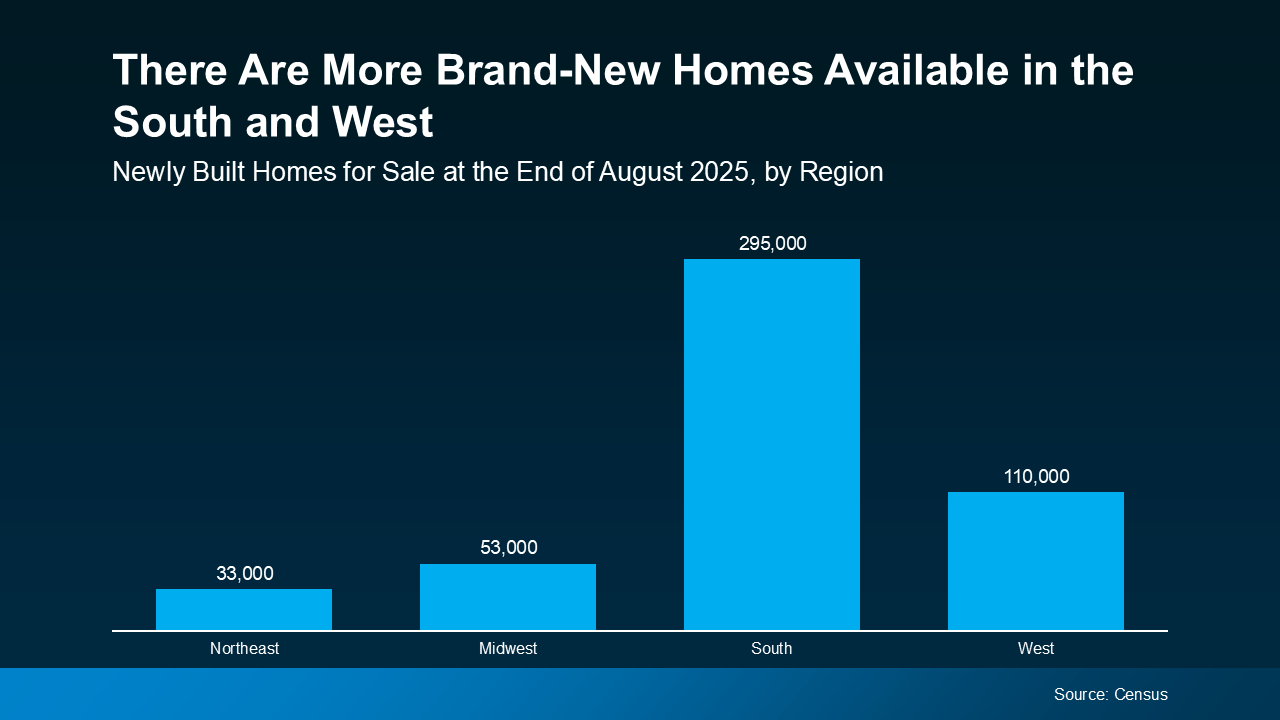 Both the South and West have more new homes available, so you may find builders are even more willing to negotiate in these regions.
Just know that this opportunity won’t last forever. Recent data shows builders are slowing down their production efforts. And a lot of that is to avoid having too many homes for sale. As Robert Dietz, Chief Economist at the National Association of Home Builders (NAHB), explains:
“The slowdown in single-family home building has narrowed the home building pipeline. There are currently 621,000 single-family homes under construction, down 1% in July and 3.7% lower than a year ago. This is the lowest level since early 2021 as builders pull back on supply.”
Moving forward, the number of new options may start to shrink as builders focus more on selling what’s already built before they add more. So, the best time in years to buy a new home may actually be right now.
Bottom Line
With builders cutting prices and maybe even helping you score a lower monthly payment, that’s not something to overlook.
If you want to see how active builders are in your target area and what they’re offering, here’s your power move: before you even begin looking, let’s connect.
That way, you have your own agent to help you compare incentives from multiple builders and negotiate on your behalf, making sure you get the best deal possible.


